
In a world of AI noise, human connection is the moat
B2B Growth Secrets (Issue #23)
Tagline: Actionable ideas from B2B Growth podcasts
Hey, I’m KP and wanted to thank you for joining the ~50,000 B2B growth leaders reading my newsletter. Each week, my team and I listen to dozens of B2B growth podcasts and share the ideas that can make the biggest difference.
In this issue:
In B2B, less is more: Do less. Do it better. Make it personal.
What started as an awkward first dinner with six people in New York has grown into Tricon's signature growth strategy.
The poor state of B2B outbound email: you have to send 10,000 emails to get just 40 MQLs!
Tool of the week 🤔
I set up a system in Claude where I type "Weekly Brief" and get a full intelligence report – competitor news, market signals, strategic implications – sourced and personalized to my business → Get the Free setup guide
Every week we’ll try to publish a new tool, which will replace the previous week’s tool so the link stays the same: tool.b2bgrowthsecrets.com
1. In B2B, less is more: Do less. Do it better. Make it personal.
B2B Resource Night keynote: “The Growth Playbook (What I Learned in 2025)” w/ Li Vijayabalan, President at TMRRW Labs and Lead Growth Consultant at RocketGrowth [March 17, 2026]
Editor’s note: For 2026, you need an events strategy. Small-group events are the best way to build strong relationships. The ones that work best make them a completely safe space with ZERO selling so that prospects keep attending.
TLDR:
Simplify your message and your product offering down to one core thing.
Use the 10-80-10 AI framework: you provide 10% direction, AI does 80% of the heavy lifting, and you spend 10% reviewing and deciding.
In a world drowning in AI-generated noise, real human connection (events, communities, personal outreach) is a massive competitive moat.
The attention math doesn't add up
The average person sees up to 10,000 ads per day, and 81% of consumers say they're ready to cut ties with brands that overwhelm them. Meanwhile, time spent on digital media is plateauing.
Netflix says they're now competing with sleep. That's how little attention is left.
So if you're posting on three platforms, running email campaigns, testing paid ads, and none of it is working? There's a good chance your audience isn't ignoring you… they literally can't hear you over the noise.
Pick one channel, simplify your message
Pick ONE marketing channel and go all-in until it generates ROI before expanding. Li calls it "less is louder." And it applies to your messaging too.
Rocket Growth's entire brand message is one sentence: "Marketing doesn't have to be rocket science." That's it. Every touchpoint repeats it. The test? If someone asks your spouse what your company does, can they answer in one sentence?
The same goes for your product offering. He shares an example of an HR consultant in Florida who offered too many services. Nobody knew where to start. They packaged everything into one "HR Success Starter Package" at a fixed rate, and suddenly it was easy to sell.
The 10-80-10 AI framework
Li uses AI all day, every day, and recommends a simple mental model:
Spend 10% of your time giving AI rich context (talk to it for five minutes, give it background).
Let AI do the 80%: research, writing, analysis, calculations.
Then spend 10% reviewing and making decisions on the output.
Li is using it for everything from contract redlining to press release distribution to pricing strategy.
Build real human connection, while everyone else is automating
While everyone doubles down on AI-powered outreach, Li is going analog.
His team built a custom tool (using AI, ironically) that sends 500 personalized letters per month to US businesses. Each letter includes a handwritten-style note, a QR code linking to a personalized video where he says the recipient's name, and a Canadian looney coin tucked inside (because lumpy mail always gets opened).
Total cost: $4 per outreach. If even 1 in 10 books a meeting, that's $40 per high-ticket appointment.
The bottom line
The businesses that win won't be the ones producing the most content but the ones with the clearest message, the smartest use of AI to free up their time, and the willingness to build genuine relationships in a world that's increasingly automated.
2. What started as an awkward first dinner with six people in New York has grown into Tricon's signature growth strategy.
The C-Suite Marketing Perspectives Podcast: The Trust-First Advantage in Modern B2B Growth w/ Seth Carpien, Chief Growth Officer at Tricon Infotech, and Misti Fragen, VP of Change Management and Digital Transformation at Tricon Infotech [March 17, 2026]
Editor’s note: As someone who’s hosted small-group dinners, they get better over time. The first may be a bit awkward, but you learn and iterate. For example, it’s much better when you invite half-friendlies and half-newcomers, and it helps if you do a quick virtual call to get to know each guest in advance so you can facilitate intros and conversations.
TLDR:
Forrester's latest prediction: trust is now the currency of B2B sales, and most companies don't have a trust-building program… just brand and demand gen programs.
Tricon Infotech's "Table" strategy – small, curated dinners with no sales agenda – grew from one awkward dinner to a multi-city quarterly program that now drives serious pipeline.
Research shows that on Day 1 of a buying decision, prospects pick 4-5 companies to consider and award the deal to one of them over 90% of the time. If they don't already trust you, you're out before you start.
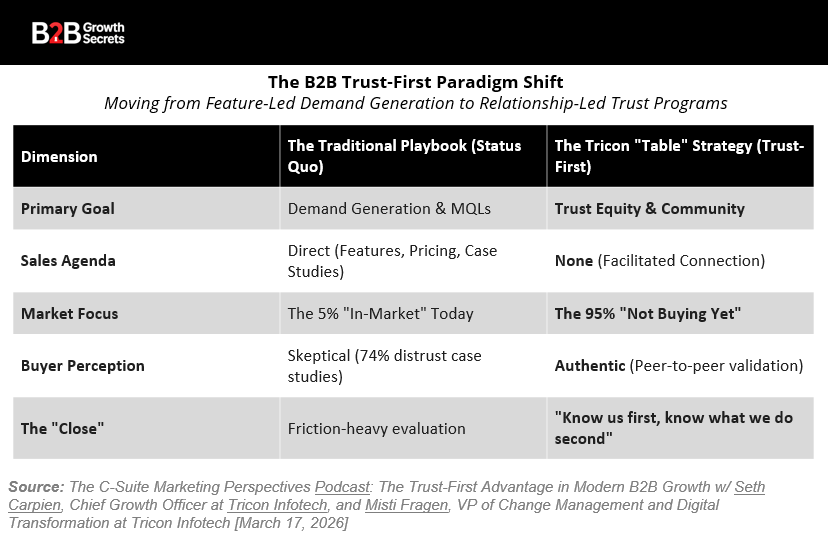
Know us first, know what we do second
Seth shared this story: he was sitting in a prospect's office ready to close a deal when the person looked at him and asked, "So, what do you guys do again?" They'd built so much trust through months of relationship-building that the prospect was ready to buy before even understanding the full product offering!
Seth's career in financial services taught him this early. People have to trust you before they give you their money. In B2B services, where you're not selling a tangible product, you're essentially selling your trustworthiness.
This flips the traditional sales playbook. Most companies lead with features and pricing. Seth argues you should lead with trust and relationship. Then the product conversation comes naturally.
The trust deficit is worse than you think
A recent study found that 74% of B2B buyers don't believe the customer evidence (like case studies) that companies present to them.
The LinkedIn-Edelman Trust Barometer found that 68% of 32,000 respondents worldwide believe business leaders are being intentionally misleading. That's why buyers are waiting longer and longer to even talk to vendors.
Forrester's latest predictions go further, calling trust "the currency" of B2B sales and noting that while companies have brand programs and demand gen programs, almost nobody has a dedicated trust-building program.
"The Table": small dinners, big results
The concept is simple: host small, curated dinners (around 6-8 people) in cities where you have existing networks – no sales pitch, no agenda, just good conversation over food and wine.
At that first dinner, Seth felt pressured to describe what Tricon does and he recalls it immediately drained the energy from the room. So they stopped doing that.
Now the dinners are purely about connecting interesting people and building community. The result? A year and a half later, they host quarterly tables across New York, Philly, Boston, and Chicago. New York got so popular they now run two dinners per visit.
Five out of six attendees at that very first dinner asked "When are we doing this again?" – and the flywheel started spinning.
The bottom line
Research from Bain and Google shows that on Day 1 of a buying decision, companies pick 4-5 vendors to evaluate – and over 90% of the time, they award the deal to one of those companies.
If you haven't built trust with the 95% of the market that isn't buying today, you won't be on that list when they are. Start small: invite six people to dinner with zero sales agenda. Do it quarterly. The pipeline will follow.
3. The poor state of B2B outbound email: you have to send 10,000 emails to get just 40 MQLs!
Masters of email marketing virtual event, Session “CRM-driven B2B lead nurturing: from segmentation to sales handoff” w/ Ieva Salina, Head of Global Marketing at Caljan ((a 60-year-old Danish conveyor manufacturer)) [March 17, 2026]
Editor’s note: The internet says cold-to-MQL conversion should be 1-5% and up to 15% for highly targeted lists. Catjan blasted 10,000 contacts to land 40 marketing-qualified leads (not closed deals), which is just a 0.4% MQL conversion!
TLDR:
A European industrial company used a 4-email sequence with lead scoring to test the US market, landing 40 marketing-qualified leads from 10,000 contacts, each worth $100K+ in potential revenue.
They segmented by industry, region, revenue size, and job title, then built content addressing pain points across all buyer personas in the decision-making group.
A two-way feedback loop with sales was the biggest factor in making the system work.
The research phase
Before sending a single email, the team spent significant time on research. They identified target companies by industry (fashion and retail), region (US markets with the highest potential), and revenue (to filter for companies that could actually afford $100K+ equipment).
Then, they mapped buyer personas – engineering, operations, distribution, and procurement – because in B2B, the buying decision involves 20-25 people at some companies.
Each persona has different pain points, so the content had to speak to all of them simultaneously. They used ZoomInfo and Cognism to build a list of 10,000 contacts matching these criteria.
The 4-email trust-building sequence with built-in filtering
Email #1 established credibility and industry expertise. If a recipient opened or clicked, they got email #2 10 days later. If they didn't open, they received the same email with a different subject line. If they still didn't engage, they were removed from the sequence entirely. This wasn't about blasting everyone. It was designed to filter out uninterested contacts and surface the ones worth talking to. They supported the whole campaign with Google Ads (targeting competitor and brand names) and Meta retargeting for landing page visitors.
The scoring system
Each engagement action earned points: 10 for an open, 20 for a click. When someone hit 100 points, they were flagged as a marketing-qualified lead and pushed into the CRM with relevant tags.
When handing leads to sales, they didn't just pass a name. They included which links the person clicked, ZoomInfo intelligence on whether the company was hiring or building new warehouses (expansion signals), and any intent data showing active online searches for relevant products.
One important caveat: they had to manually filter out bot activity from corporate spam filters that auto-click every link, decreasing scores for contacts that clicked everything.
The bottom line
From 10,000 contacts and 50,000+ emails, they generated 40 marketing-qualified leads. For equipment costing $100K+, one closed deal would make the entire campaign worthwhile.
Disclaimer
B2B Growth Secrets summarizes and comments on publicly available podcasts for educational and informational purposes only. It is not legal, financial, or investment advice; please consult qualified professionals before acting. We attribute brands and podcast titles only to identify the source; such nominative use is consistent with trademark fair-use principles. Limited quotations and references are used for commentary and news reporting under U.S. fair-use doctrine.
