
Your TAM isn’t 30,000. It’s 647.
Hey, I'm KP 👋 Join my quest to interview 100+ B2B growth experts to learn what actually works, and what the top operators do differently. Enjoy the best ideas from the "Compound Growth" roundtable below. And stay tuned for the official launch ofCompound Growth LIVE.
Meet the Guests
Kirko Papajanis: Fractional RevOps and marketing leader with 25 years in B2B marketing, sales, and revenue operations. Ran a B2B marketing agency in Toronto for over a decade and now works across departments to unify revenue-generating functions. Strong opinions on tearing down silos.
Declan Mulkeen: CMO of strategicabm, a UK-based Account-based Marketing agency. After 20+ years as a CMO in Professional Services, SaaS, and EdTech, Dec is now agency-side helping B2B companies design and run ABM programs. Hosts the Let's Talk ABM podcast (85+ episodes). Lives in the mountains north of Madrid.
Aram Taghavi: Co-Founder & CEO of Optin. Was employee #2 and CRO who helped grow Bisnow Media to 1M+ subscribers across 30+ newsletters and 300 events a year. Now helps B2B brands grow newsletters using proprietary cold email infrastructure, and publishes six private-markets-focused newsletters of his own.
Key Takeaways
Your real TAM is probably much smaller than you think. One company thought they had 30,000 target accounts. The actual number was 1,200. Shrinking the target made everything else – content, outreach, ABM – dramatically more effective.
ABM is a mindset, not a campaign. The companies winning with ABM treat it as a company-wide culture, not a marketing tactic. Everyone from Product to C-suite knows the names of their most important accounts.
Fix the handoff before you fix the funnel. RevOps improvements don't require massive overhauls. Sometimes just aligning marketing and sales on what pipeline stages mean – and making handoffs trackable – creates an immediate cascade effect.
Companies wildly underestimate how big their newsletter can get. If you have 5,000 subscribers, the real number should be 50,000. Great content sent to the right people at work retains better than most expect.
What Good Operators Do Differently
They shrink their target before they scale their outreach.
Kirko: A company believed their TAM was 16,000 print shops. When we researched what drove purchase decisions, the real market was 647. We found micro cohorts within that and targeted them with one-to-few content. 18 months later, $12 million in net new pipeline ($4M in 9 months) and 12x Lean to Opportunity conversion improvement. Most companies skip the strategic data intelligence step and go straight to blasting the biggest list they can find, diluting their message and effort – and then they wonder why nothing works for them! [Case study infographic]
They prove the model with one account before rolling it out to 81.
Dec: Aveva came to us and said they'd never done ABM. We started with one account: GSK. We built a Forbes-style magazine, created a digital workshop, and sent VIP invitations to their global event. That one program generated $9 million in pipeline. Today, Aveva runs ABM into 81 accounts. Last November they won the Forrester B2B Program of the Year. But it all started with one. [Read the full case study here]
They treat the newsletter as an asset, not a campaign.
Aram: The companies that do newsletters well understand it's a long game. You're building an asset. It's more top of funnel than bottom of funnel. You may not drive direct sales but you WILL stay top of mind week in and week out. The vast majority of your buyers aren’t in-market all the time, so you just want them to know you for when they need you. We have a client we've grown from zero to 400,000 subscribers. Their average open rate is 48%, click-through rate is 3.6%. When you reach that scale, THEN you can generate leads weekly. But it takes patience.
On RevOps and Breaking Down Silos
KP: Kirko, you've been a CRO and VP of RevOps at several companies. What's the most common problem you walk into?
Kirko: An information misuse problem. Companies implement a CRM with the best intentions. Everyone's excited. Then over time, people change the pipeline stages, nobody agrees on what each stage means anymore, and the whole system falls apart. The C-suite asks why they're not hitting numbers. Sales blames marketing for bad leads. Marketing says sales isn't following up. That's where I come in: align on what the stages are, who's responsible for what, and making the handoffs tight so there's no finger pointing.
KP: What does a “fix” actually look like?
Kirko: I'm working with a managed service provider now with a team spread across Canada, the US, and Europe. The European team was working off spreadsheets. Leads from the central marketing team were getting lost. We focused our first sprint just on the handoff between marketing and sales, making everything trackable. Immediately we saw an activity increase on the European sales side. And we discovered that the global marketing content wasn't applicable to the European market. That real-time feedback let us reshape the strategy for each region. Small changes, cascade effects.
On ABM: What It Actually Looks Like When It Works
KP: Dec, you see ABM as a mindset across an entire organization. Can you share an example of how ABM works that way and what it looks like?
Dec: One of my podcast guests, Christian Weiss at Autodesk, had the best analogy: your customer is the Formula One car. Your job is to help that car win. When it pulls into the pit, you've got people changing tires, filling the tank, and cleaning the windscreen. Each of those people is a different team – marketing, sales, customer success, product. All working together to help that car cross the finish line.
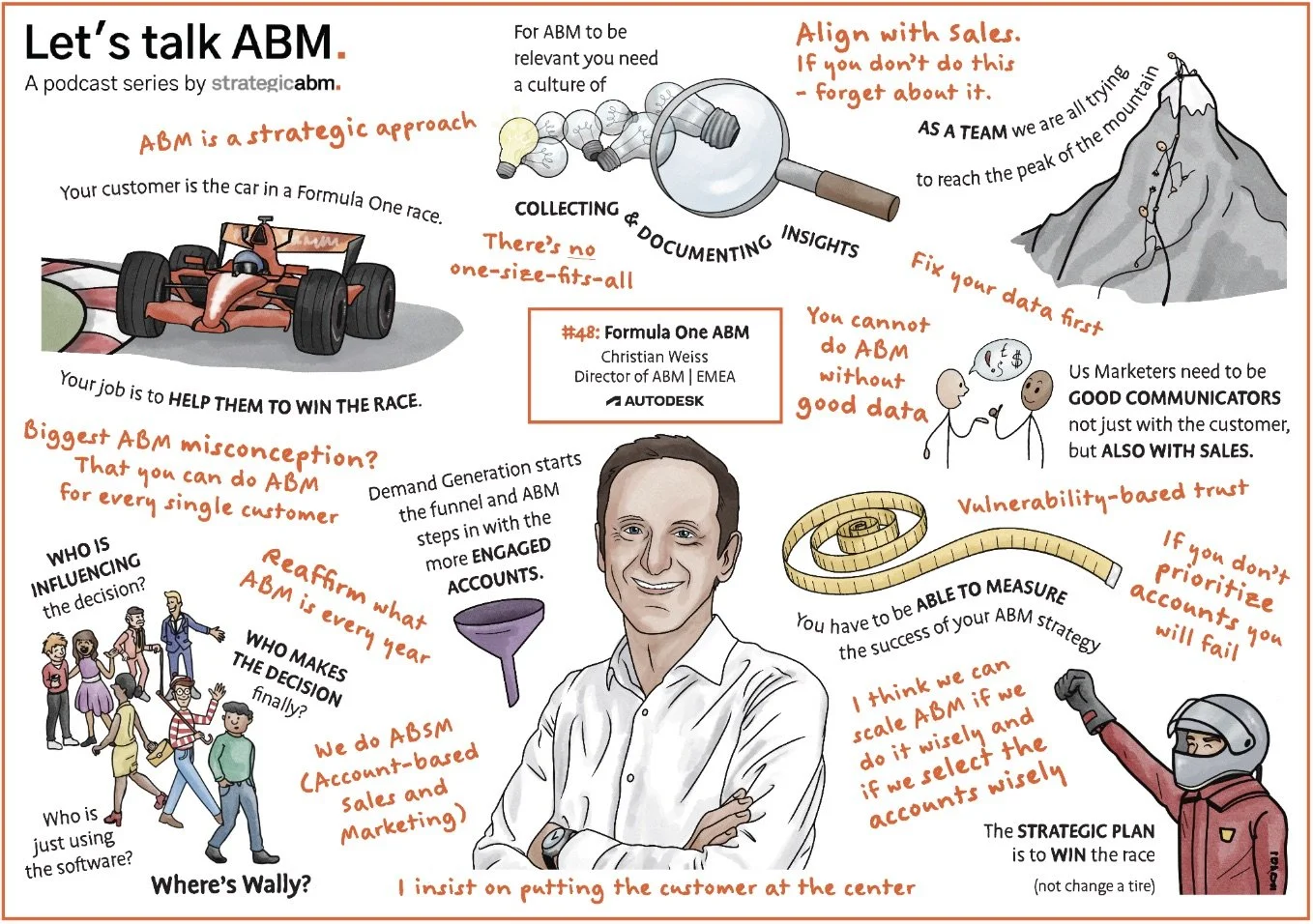
KP: What does that look like in practice?
Dec: Aveva is a billion-dollar industrial software company. They'd acquired so many companies that their customers didn't even know the Aveva brand – they knew the legacy brands. They came to us and said: help us with one customer, GSK. We need to be part of GSK's 2030 agenda.
So we built a peer-to-peer campaign. We used Aveva's Chief HR Officer as the face of it – because nobody wants to talk to salespeople, but peers talk to peers. We created a Forbes-like magazine with in-depth articles tailored to GSK's leadership, ran a digital workshop on aligning with GSK's objectives, then sent VIP invitations to Aveva's global event. That generated $9 million in pipeline from one account.
KP: And how are they scaling that?
Dec: The first time you run an ABM campaign, it’s a good idea to do everything very manually and go the extra mile because you’re learning a lot through iteration. That first approach was very white-glove and expensive. Now, they've boiled it down to make it easier to run across 81 accounts while keeping the same level of personalization. They call it "one-to-one at scale."
On Newsletter Growth and Where It Fits
KP: Aram, how are you growing B2B newsletters so fast?
Aram: What's different about us is that we actually send the newsletter to people cold to their work emails. I did this in the late 2000s and grew Bisnow to 1M+ subscribers. It still works. But it’s much more difficult to execute because of technology guardrails. So we built our own infrastructure and ESP specifically for this.
KP: I’m sure you hear this a lot. All the newsletter gurus out there hate cold outreach. It’s all about “opt in.”
Aram: The key insight from doing this all these years is that opt-out retention is actually better than opt-in. In fact, I’ve built a double opt-in newsletter in parallel, and the engagement metrics are far superior to my ‘cold’ newsletter!
People at work will keep reading something that's genuinely useful to their jobs, even if they didn't subscribe. Our unsubscribe rates are very low.
And companies wildly underestimate how big their newsletters can get. Someone will say "I've got 5,000 subscribers" and our message is: that number should be 50,000. We target senior people at work emails, and the retention and onboarding is much higher than people expect.
KP: Kirko, how do newsletters fit into the broader RevOps and ABM motions?
Kirko: Newsletters are a great way to stay relevant to people who aren't in market yet. You're not just thinking about your own product – you're thinking about the industry. And when you put out diverse content, the engagement signals tell you a remarkable amount about who your subscribers are. Identifying those signals and feeding them into your decision-making… that's where the real operational value is.
