
AI made startups cheap, brand is now the moat
Learn AI from experts building the future of B2B Growth. We're launching AI Skills workshops to help you understand trends, build custom tools, and automate workflows.
Reply “Skills” to save your spot as a Founding Member (the first 100 get 50% lifetime discount).
In this issue:
With AI making it easier to build startups, brand awareness is now your competitive moat
The combination of automated booking + employees’ personal brands will separate pipeline leaders from the pack
Address buyers’ “fear of messing up” (FOMU) by de-risking their decision
1. With AI making it easier to build startups, brand awareness is now your competitive moat
The Campaign podcast: Brand, Pricing, and How to Build an Unfair Advantage w/ Bill Macaitis, former Slack CMO/CRO (1/27/26)
Bill Macaitis spent 20 years powering growth at Slack, Zendesk, and Salesforce. His take on 2026 is that the explosion of AI-native startups means you'll face 10x more competitors. And if nobody knows who you are, you'll lose before the deal even starts.
Brand is your new pipeline
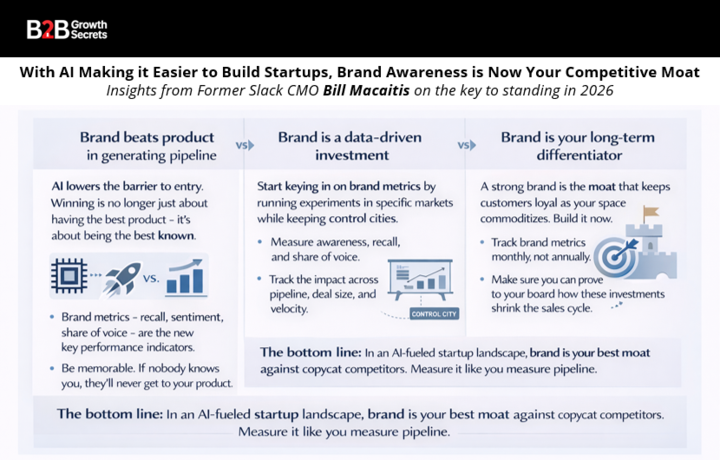
Most B2B marketers obsess over leads and pipeline. Macaitis argues they're missing the leading indicator: brand metrics. When he joined Slack as one of the first 50 employees, the team immediately started tracking aided recall (do people recognize your name when prompted?), unaided recall (do they remember you without prompting?), sentiment, and share of voice. They ran these surveys monthly and watched the graphs climb alongside revenue.
The insight? Brand equity is future pipeline. When buyers enter a buying cycle, they've typically done 75% of their research before talking to sales. If they don't already know and trust you by then, you won't make the shortlist.
How to prove brand investment works
Boards want data. Here's how Macaitis made the case: run brand campaigns in specific markets – say, Atlanta or Philadelphia – while keeping similar "sister cities" as controls. Then measure the difference. Not just in awareness and recall, but in pipeline generated, average deal size, and deal velocity.
The result at Slack? Brand campaigns created demand. Salespeople walked into accounts where prospects already knew who they were, had heard good things, and wanted to work with them. Deals closed faster and bigger.
The bottom line
If you're heading into 2026 without tracking brand metrics, you're flying blind. Start monthly surveys, run geo-targeted experiments, and measure the impact on your sales cycle.
2. The combination of automated booking + employees’ personal brands will separate pipeline leaders from the pack
Future Proofed podcast: Cold Email Still Works Here Is the System That Books 300 Meetings a Month (1/13/26)
TLDR:
The magic formula combines cold outreach for volume with personal brand building for trust.
An AI autoresponder can handle everything from "interested" reply to booked meeting. 90% of bookings require zero human involvement.
Employee-generated content is an untapped channel that can drive 80,000+ impressions from just four posts.
Parker Mayes, co-founder and CEO of Inbound Revenue, has spent 3 years cracking what he calls "the hardest channel" – cold email. His agency now books over 300 meetings per month across a few dozen marketing agency clients. But the real breakthrough isn't the outreach itself. It's what happens after someone replies.
The AI autoresponder that replaced follow-up
When a prospect responds positively to a cold email, most teams scramble to reply quickly and schedule a call. Parker's team built an AI system that handles the entire back-and-forth conversation from "interested" to calendar booking.
The system integrates with their CRM (High Level) API to check availability, suggest times, confirm bookings, and handle objections – all automatically. About 90% of their completed meetings involve zero human interaction after the initial reply comes in.
This matters because follow-up speed kills deals. When a human has to manually respond, availability windows close, momentum dies, and meetings fall off. The AI eliminates that friction entirely.
Why employee-generated content is the next big channel
Parker’s prediction for 2026: companies that crack employee-generated content will see massive pipeline growth within six months.
One of his team members, Gavin, posted just four times on LinkedIn in a single week and generated 80,000 impressions. Those posts directly drove 3+ sales bookings. His top-performing post? A four-line joke about doing cold calls in a sauna.
The challenge is that most companies don't enable this. Parker identifies three barriers:
it takes too much time and creativity per person,
companies don't reward it, and
without early traction, people quit.
His thesis is that solving for accountability, creative support, and incentives could unlock a multiplier effect across your entire sales team.
Cold outreach still works, but the game changed
Parker shared the two variables that determine cold email success: triggers and volume. Either you're reaching out based on signals (new hires, recent posts, job changes) to catch people at the right moment, or you're playing a massive volume game reaching tens of thousands of people per month.
The campaigns that convert best use human-written templates with AI-powered personalization fields like industry, competitors, recent hires, role changes. Pure AI-generated emails still underperform compared to this hybrid approach.
The bottom line
If you're running cold outbound, stop treating follow-up as a human job. Build or buy an AI system that handles the entire booking flow after someone replies "interested." And if you want a longer-term play, start enabling your team to post authentically on LinkedIn – not polished corporate content, but real personality.
3. Address buyers’ “fear of messing up” (FOMU) by de-risking their decision
Revenue Engine Masters podcast: B2B Marketing vs Sales Alignment + Customer-Led Growth in Private Equity (11x CMO Insights) (1/26/26)
TLDR:
Only 5% of your target market is actively buying at any moment. The other 95% need nurturing.
Well-aligned marketing and sales teams grow 19% faster and are 15% more profitable.
Winning deals isn't just about FOMO; you must also de-risk the "fear of messing up."
Allan Gonsenhauser has been CMO eleven times and now advises PE-backed companies. His core message: stop treating marketing as a lead factory and start treating brand as your future pipeline.
The math that changes everything
At any given time, only about 5% of companies in your target market are actively in a buying cycle. The other 95%? They need to be nurtured until they are. By the time prospects start evaluating solutions, they've already done three-quarters of their research.
This is why aligned companies – where marketing, sales, product, and customer success share common goals – grow 19% faster and are 15% more profitable. Marketing builds the brand equity that gives sales more swings at the plate.
From FOMO to FOMU: why deals really stall
There's a shift in buyer psychology that most sales teams miss entirely. Traditional selling leans on fear of missing out (FOMO): "You'll save money! You'll be more productive! Don't miss this opportunity!" But Gonsenhauser points to research from Matt Dixon's book The Jolt Effect that reveals a deeper problem: buyers also carry fear of messing up (FOMU).
Here's how FOMU sounds inside a buyer's head: "If I make this decision and it doesn't work, it's on me. I failed. My reputation takes a hit. Maybe I lose my job."
This fear is especially acute in today's market. With economic uncertainty and increased scrutiny on every purchase, the personal risk of making a wrong choice feels higher than ever. And here's the painful truth: FOMU kills more deals than competitors do. Prospects don't always say "we went with someone else" – they say "we've decided to hold off" or simply go dark.
How to de-risk the decision
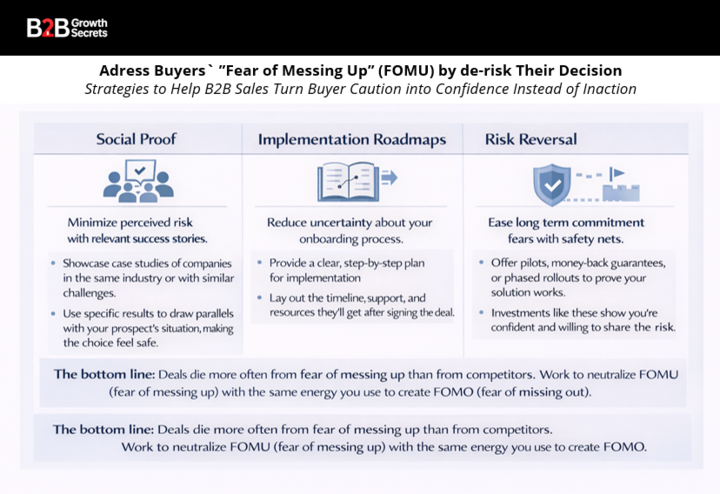
Your sales process needs to actively neutralize FOMU, not just amplify FOMO. Here's what that looks like in practice:
Social proof with specificity: Generic case studies don't cut it. Show prospects companies like theirs – same size, same industry, same challenges – who succeeded with your solution. The more similar the reference, the safer the decision feels.
Implementation roadmaps: Buyers fear the unknown. Walk them through exactly what happens after they sign: who's involved, what the timeline looks like, what support they'll get. Reduce ambiguity.
Risk reversal: Guarantees, pilots, phased rollouts… anything that lets them test before fully committing. You're not just selling a product; you're selling confidence that this won't blow up in their face.
Champion enablement: Your internal champion has to sell this decision to their colleagues and bosses. Give them the ammunition – ROI calculators, executive summaries, objection-handling guides – to defend the choice.
Every deal has both a dream to chase (FOMO) and a fear to address (FOMU). Most sales teams only work one side. Work both, and you'll unstick deals that would otherwise die in "no decision" limbo.
The bottom line
Build brand equity today so you're already known when buyers enter the market. Align your go-to-market teams around common metrics. And remember: every deal has both a dream to chase and a fear to address.
Disclaimer
B2B Growth Secrets summarizes and comments on publicly available podcasts for educational and informational purposes only. It is not legal, financial, or investment advice; please consult qualified professionals before acting. We attribute brands and podcast titles only to identify the source; such nominative use is consistent with trademark fair-use principles. Limited quotations and references are used for commentary and news reporting under U.S. fair-use doctrine.
