
Stop Creating Cheap Offers. Fix Your Constraints.
Welcome to B2B Growth Secrets, where every week, we listen to dozens of B2B Growth podcasts and extract the top actionable ideas. (For more context on these ideas, give the podcasts a listen)
In this issue:
Alex Hormozi’s advice: Your response to capacity constraints should be to fix them, not create a new lower-tier offering
High-ticket sales are easier because low-ticket buyers focus on price and convenience, while high-ticket buyers focus on outcomes
If your buyers don’t already have a budget for your solution, you’re selling vitamins and should be prepared for a brutal uphill battle
1. Alex Hormozi’s advice: Your response to capacity constraints should be to fix them, not create a new lower-tier offering
Alex Hormozi podcast: If I Wanted To Scale A Service Business In 2026, Here's What I'd Do (1/30/26)
TLDR:
The common mistake: building a new low-touch product when you should be fixing capacity constraints in your existing high-ticket offer.
Unlimited access features (Slack, custom planning) are often the culprit. Remove them from high-ticket offers instead of creating a separate tier.
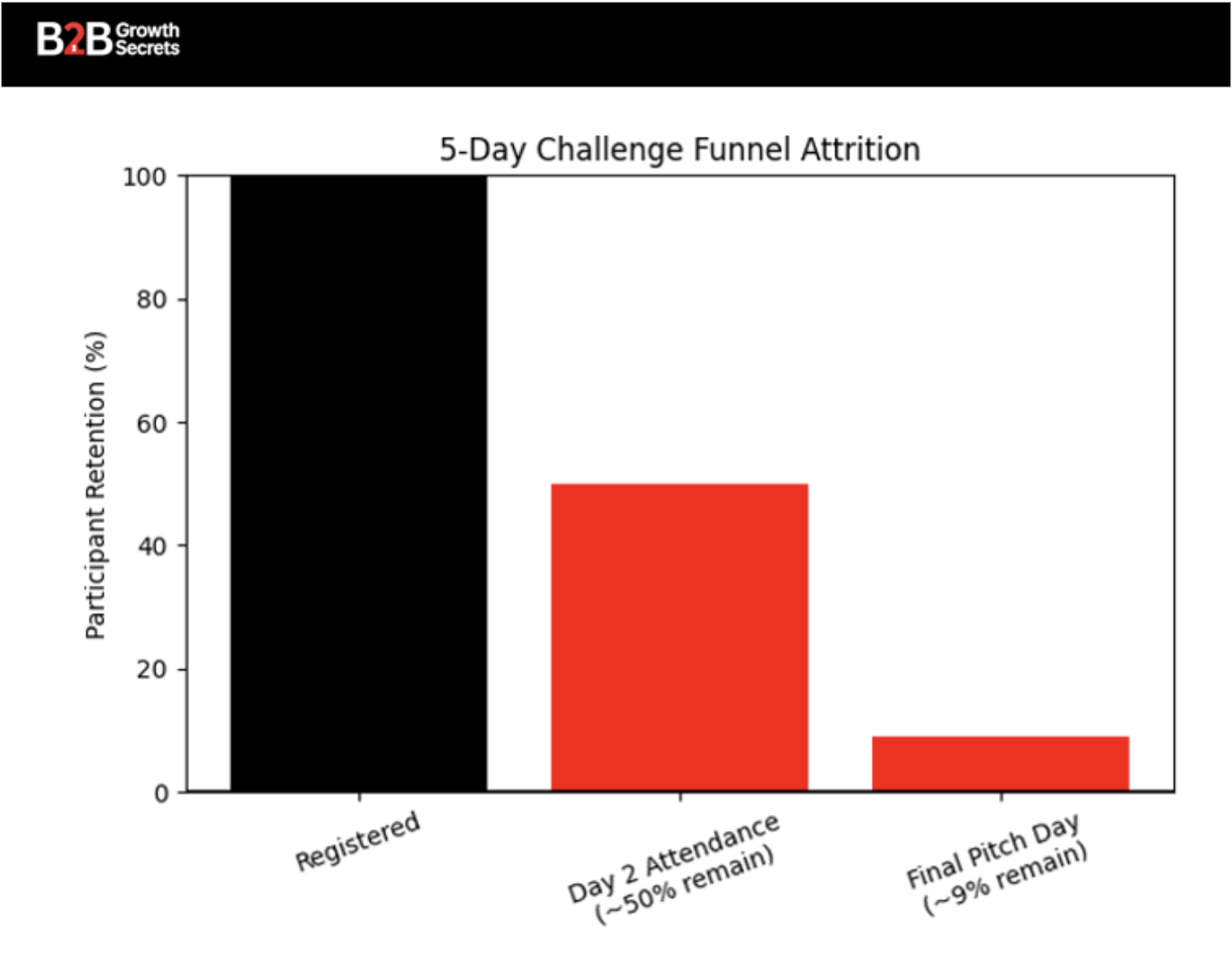
Challenge funnels (5-day formats) typically see 50% drop-off after day 1; compress to single 4-hour "date night" events instead
Alex Hormozi sees constantly this problem in service businesses: founders create new products to solve capacity problems when they should be fixing the products they already have.
The wrong response to capacity constraints
Here's the pattern: a high-ticket service business ($5K-$25K offers) is working. Customers are happy, referrals are strong. But the founder is burning out because the offer includes time-intensive elements like unlimited Slack access, custom planning calls, or always-available consulting.
The typical response is to create a lower-priced, lower-touch offer: "Let's build a DIY course for people who can't afford the premium service." This sounds logical but often makes things worse.
Why? Because you've just created two problems: the high-ticket offer still has unsustainable time requirements, AND you now have a lower-margin product that needs its own marketing, sales, and delivery infrastructure.
Instead of building something new, remove the time-intensive elements from your existing high-ticket offer. Keep the price, improve the margins, free up capacity. Most clients don't actually need unlimited Slack access, they just need results.
Identifying what's actually causing burnout
The elements that sound premium – unlimited access, always-available support, custom everything – are often the exact things making your business unscalable.
Hormozi suggests auditing your offer: which elements consume the most time but contribute least to client outcomes? In his experience, it's usually communication access and custom planning that creates false urgency.
Clients feel good knowing they COULD message you anytime. But most don't need to, and the ones who do are often less successful anyway because they're dependent rather than implementing.
Remove the high-touch elements, replace them with clear processes and defined touchpoints, and you often get better results with less time. Counterintuitive, but consistently true.
Why ‘challenge’ funnels underperform
Hormozi also addresses the popular "5-day challenge" funnel structure. The data he shares: 50% of registrants drop off between days 1 and 2, and only about 9% show up for the final pitch day.
The problem is friction. Every day is another opportunity for life to get in the way. Five separate commitments over five days is hard for busy professionals.
His recommendation: compress the challenge into a single "date night" format: a focused 4-hour event where people commit once and stay engaged. Completion rates and conversion rates both improve dramatically when you reduce the number of separate commitments required.
This applies beyond challenges: whenever you're designing a customer journey, count the number of separate commitment points and look for ways to consolidate them.
The bottom line
Before creating new products to solve capacity problems, audit whether you're creating your own constraints. High-touch elements that sound premium often undermine scalability without improving outcomes. Remove what drains time without delivering value.
2. High-ticket sales are easier because low-ticket buyers focus on price and convenience, while high-ticket buyers focus on outcomes
Webinar, High Ticket Sales Mastery: How Raymond Lim Built a $20M Empire in Consultancy & Insurance Sales (2/4/26)
TLDR:
High-ticket buyers are solution-focused, not price-focused. If they ask for discounts, you haven't achieved emotional and logical certainty.
Price your services at 3% or less of the client's revenue or income. Below that threshold, decisions become easy.
Stop hunting for clients and start attracting them through LinkedIn, structured networking, and media visibility.
Raymond Lim leads a team of 180+ commission salespeople generating over $20M annually in Singapore. He's closed corporate deals exceeding $200,000 in a single transaction. His counterintuitive insight: selling high-ticket is actually easier than selling low-ticket.
Why high-ticket sales close easier than low-ticket
Low-ticket buyers focus on price and convenience. High-ticket buyers focus on outcomes and domination. They want to be number one in their industry or domain.
This changes everything about the sales conversation. Low-ticket buyers ask "What's the cheapest option?" High-ticket buyers ask "What outcome can you help me achieve?" When you're selling to someone who wants to dominate their market, price becomes secondary to results.
Raymond's experience: in all his high-ticket sales, price is never discussed first. Once you achieve both logical certainty (they understand the solution) and emotional certainty (they feel confident in you), the price just needs to be revealed. If the previous steps are done correctly, they buy.
The 3% rule for effortless closes
Raymond uses a simple framework for pricing: anything under 3% of a person's income or company's revenue requires almost no consideration. For example, a $30,000 service to a company doing $1M annually is exactly 3%, below the threshold where people overthink.
The breakdown:
Under 3%: Simple close, minimal resistance
3-5%: Requires more certainty and proof
5-10%: Needs case studies and demonstrated frameworks
Above 10%: Significant challenge… you're cutting into their profit
This means if you want to close million-dollar deals, you need to target hundred-million-dollar companies. At 1% of revenue, the decision becomes easy.
From hunting to attracting
Raymond spent his early years hunting for clients – networking randomly, searching constantly. It wasn't effective. The shift came when he built systems to attract clients instead.
His three-channel approach:
LinkedIn profile: Optimized specifically for corporate deals, showcasing expertise and results
Structured networking: Rather than random events, he runs his own networking arrangements where he knows exactly who attends
Media visibility: Getting featured in media so prospects discover him organically
The key insight: if clients come to you through a proper funnel, the deal is already 50% closed. They've self-selected based on the outcome you promise.
Show them the "after"
Once you've achieved certainty and the pricing fits, the final step is showing clients a clear timeline of what they'll achieve. Raymond calls it "the before and after" – explaining exactly who they'll become or where their company will be after working with you.
For corporate clients, frame the outcome around their personal stakes: Will this help them get promoted? Keep their job? Hit their numbers? The person hiring you has problems to solve, and your solution should map directly to their professional survival or advancement.
The bottom line
High-ticket sales isn't about convincing, it's about qualifying. Find buyers who are solution-focused rather than price-focused, price below 3% of their revenue, build logical and emotional certainty before revealing price, and show them exactly who they'll become after working with you. If they ask for discounts, you haven't done the previous steps right.
3. If your buyers don’t already have a budget for your solution, you’re selling vitamins and should be prepared for a brutal uphill battle
The SaaS podcast: He Spent 7 Years Selling a Nice-to-Have. Then Everything Changed. (2/19/26)
TLDR:
If buyers don't already have budget allocated for your solution category, you're selling a vitamin, and that's a brutal uphill battle.
Validate by finding buyers who are already spending money on your problem before building.
Your startup ideas should come from personal pain points you've actually experienced.
Adam Markowitz spent seven years building Portfolium, an edtech platform that helped students showcase their skills to employers. The company eventually sold for $43 million, but the journey was brutal. The problem wasn't the product. It was that universities didn't have a budget line item for "student portfolio tools."
What it means to sell a vitamin vs. a painkiller
When buyers already have budget for a solution category, you're selling a painkiller. Someone has a migraine, and you have aspirin. Easy.
When buyers have to create a new budget line just to buy from you, you're selling a vitamin. You have to convince them they need it, then convince them to find money for it, then convince them to prioritize it over things they already planned to buy. That's three sales instead of one.
At Portfolium, Adam was pitching universities that had never budgeted for portfolio software. Every sale required him to create demand from scratch while competitors fought over the same finite dollars.
How Drata found the painkiller
When Adam started his second company, Drata (a compliance automation platform), everything changed. Compliance frameworks like SOC 2 and ISO 27001 aren't optional, they're requirements to win enterprise deals. Companies were already paying consultants, auditors, and internal teams hundreds of thousands of dollars to achieve compliance manually.
Drata didn't need to convince anyone the problem existed. They just had to show a better way to solve it. Result: over $100 million in revenue before their fourth birthday and 8,000+ customers.
The validation question every founder should ask
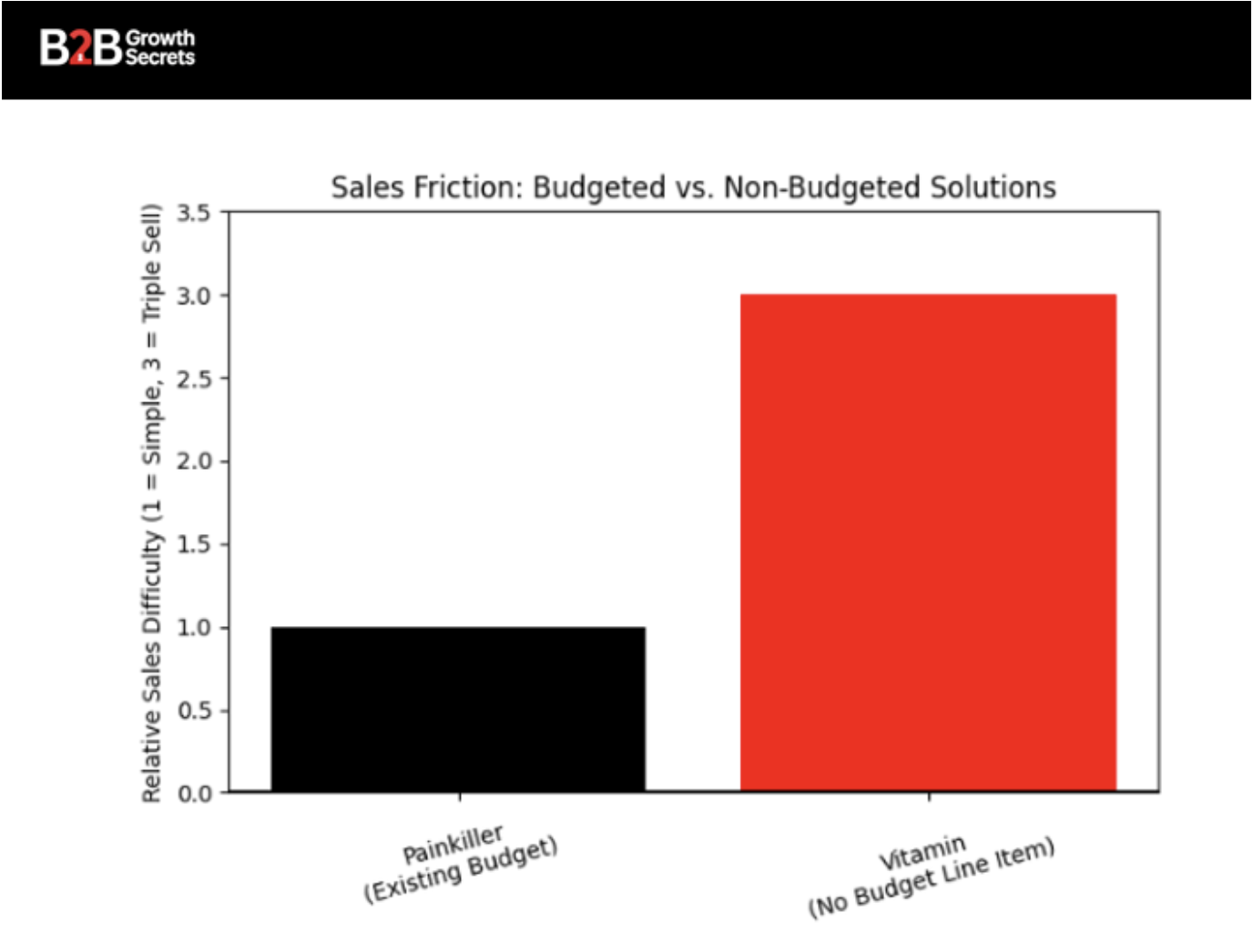
Before building, find 10 potential buyers and ask: "What's your current budget for solving this problem?" If they give you a number – even if it's going to a competitor or manual workaround – you've found a budgeted line item. If they say "we don't have budget for that," you're about to sell vitamins.
The bottom line
The fastest path to B2B growth isn't a better product. It's finding a problem buyers are already paying to solve. Before you write a line of code, prove that potential customers have money allocated for your solution category. If they don't, you're not building a company, you're building a missionary sales organization.
Disclaimer
B2B Growth Secrets summarizes and comments on publicly available podcasts for educational and informational purposes only. It is not legal, financial, or investment advice; please consult qualified professionals before acting. We attribute brands and podcast titles only to identify the source; such nominative use is consistent with trademark fair-use principles. Limited quotations and references are used for commentary and news reporting under U.S. fair-use doctrine.
