
Niching is table stakes. Your POV is the moat.
Welcome to B2B Growth Secrets, where every week, we listen to dozens of B2B Growth podcasts and extract the top actionable ideas.
In this issue:
Actionable tactics to be different and dominate a category like Gong
Niching isn't enough anymore – you need a unique POV that creates distance from your competitors
How a founder evolved his founder-led marketing strategy to scale the business
1. Actionable tactics to be different and dominate a category like Gong
The B2B Marketing podcast: Standing Out in B2B Marketing Without a Big Budget w/ Udi Ledergor (1/28/26)
TLDR:
"Different is better than better." You don't get noticed for being 20% better, only for being 20x better or completely different.
Brand can't be owned by marketing alone; it requires company-wide operating principles like "create raving fans."
Category creation requires product-market fit first. Great marketing cannot fake a category for a product people don't want.
Udi Ledergor, author of "Courageous Marketing" and former CMO at Gong, shares how they built a revenue intelligence category through bold, differentiated marketing.
The philosophy: different is better than better
"You don't get noticed for being a little bit better. You get noticed for being 20 times better – but that's really hard to do."
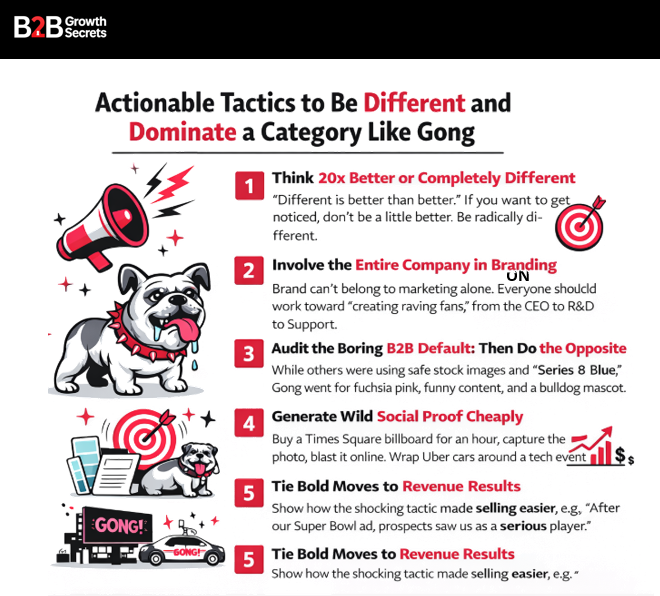
The easier approach: do something completely different. When Gong audited B2B websites in 2016, everyone used "Series 8 blue" (shades of blue with white and gray). Instead of finding a better shade of blue, Gong chose fuchsia pink and purple with a drooling bulldog mascot. "People were talking about it" because it was shocking for B2B.
Brand can't be owned by marketing
Here's a critical insight most founders miss: "If your CEO tasks you with building a brand, run the other way." Marketing can be a steward of brand, but brand is built by the entire company – from CEO to the last employee.
Gong codified this through 8 operating principles developed with employees from every function. One principle: "Create raving fans." Everyone – recruiting coordinators, customer success, engineers – works to create raving fans internally and externally.
How to actually be different
The philosophy is simple, but the execution requires discipline. Here's Udi's methodology:
Step 1: Audit what everyone else is doing. When Gong wanted to create their visual identity, they didn't start with inspiration boards. They audited dozens of B2B websites and documented what they all had in common – "Series 8 blue" (shades of blue with white and gray), safe stock photography, predictable layouts.
Step 2: Do the opposite. Instead of finding a "better" shade of blue, Gong chose fuchsia pink and purple. Instead of generic imagery, they chose a drooling bulldog mascot. In 2018, this was shocking for B2B. "People would be embarrassed to do that."
Step 3: Tie it to sales impact. The key to getting buy-in for bold ideas: demonstrate how it makes sales easier. After Gong's Super Bowl commercial, their Chief Revenue Officer reported that "people who never heard of us before or thought we were just a small startup now see us in a totally new light." That perception shift directly helped close enterprise deals.
The same applies to content. Udi's team discovered that starting a cold call with "How have you been?" outperforms "How are you?" – and salespeople who occasionally drop an F-bomb have an 8% higher win rate. These counterintuitive insights took massive data analysis to uncover, but they're immediately applicable and get shared precisely because they're surprising.
Punching above your weight (the tactical playbook)
Here's exactly how Gong appeared much bigger than they were, which was critical for selling to enterprises who don't like buying from startups:
The $500 Times Square billboard hack. You can get a Times Square billboard for as little as $500. It might only show for one hour, rotating with eight other ads. Udi's insight: "I don't care if my buyers are on the street. I'm assuming they're not."
The real play: hire a photographer to capture your billboard the moment it appears, with the crowds and iconic location visible. Then amplify those images across your social media, email subscribers, and employee networks. You paid $500 for content that makes you look like a Fortune 500 company.
The Dreamforce rideshare swarm. Instead of paying hundreds of thousands for a booth "near the bathroom that nobody would notice," Gong wrapped 20 Uber and Lyft cars with their branding. They limited the radius so cars only drove around the Moscone Center, dropping off and picking up conference attendees all day.
Result: "People saw all these ride share cars with Gong branding and thought we were way bigger than we were. They thought there were hundreds of cars." Social media posts amplified the effect. Total cost: a fraction of a booth rental.
The employee recognition billboard. Gong features their "outstanding gangsters" (employees of the year) on Times Square billboards. They buy the cheapest slot, get the employee there for a selfie, and let the magic happen. "Once you put an employee's face up on Times Square, they're not going to leave you." Three audiences benefit: the featured employee (loyalty), colleagues (motivation to be next), and candidates (culture signaling).
The Super Bowl shortcut. Gong ran a Super Bowl commercial when they were tiny compared to other advertisers. The CRO's feedback: "That completely changed our perception in the market." For enterprise sales, looking legitimate is half the battle.
The bottom line
You can't afford to be boring, especially as a startup with bigger competitors. Category creation requires genuine product-market fit first – you cannot fake it with marketing. But once you have a product people want, invest in being radically different rather than marginally better. Look to LEGO, Disney, and Adidas for inspiration – not your boring B2B competitors.
2. Niching isn't enough anymore – you need a unique POV that creates distance from your competitors
Agency Forward podcast: The Perspective-First Playbook for Agency Growth w/ Alex James (1/27/26)
TLDR:
When everyone niches down, we're back to square one – "we do X for Y" is table stakes now
The differentiator is the "Z": we do X for Y because Z (your perspective/point of view)
High-growth agencies (30-50%+ revenue growth) get only 30-40% from referrals vs 70% for slow-growth agencies
Alex James, a messaging strategist, delivers a critical insight for any founder or agency: niching was the strategy. Now it's just the starting point.
The niche paradox
"A niche isn't enough anymore because when everyone does it, we're back to square one." The advice to niche down has been crammed down everyone's throat for years. The problem? It worked so well that now everyone is doing it.
Alex shares an example: a freelance graphic designer who niched to authors "because that's what you're supposed to do." But when asked about book design, what publishers want, or what sells on shelves, he had nothing. "We followed the letter of the law, but not the spirit of the law."
The positioning distinction
Here's the critical difference most people miss: niching is about focus (who you target), while positioning is about perception (how you're seen in the buyer's mind). You need both.
The formula: We do X for Y because Z. That "because Z" is your perspective – the justification for why you do what you do in the way you do it. It's not just about being a "local SEO agency for gyms." It's about having a point of view on why gym SEO specifically requires your approach.
How to actually develop your perspective
So how do you find your "Z" – the perspective that makes your positioning defensible? Alex points to a few practical approaches.
Start with your origin story. Why did you start this business in the first place? What frustration or broken approach did you see in the market? Your perspective often lives in whatever made you say "there has to be a better way." If you niched into gym SEO because you owned a gym and saw how badly most SEO agencies understood the fitness business model, that's your perspective: you understand the unit economics and seasonal patterns that generalist agencies miss.
Identify what you believe that others don't. A strong perspective is often contrarian. What do most people in your space get wrong? What conventional wisdom do you reject? For example: "Most SEO agencies focus on rankings, but rankings don't pay the bills. We focus on revenue per search term." That's a point of view that creates distance from competitors.
Look at your best client wins. Examine your most successful engagements. Why did they work so well? Usually there's a pattern: a specific approach, a unique process, or an insight about the problem that you brought to the table. That pattern is often your perspective waiting to be articulated.
Test it through content. Alex emphasizes the importance of broadcasting your perspective consistently. But this also serves as a testing mechanism. Share your point of view on LinkedIn, in your newsletter, on podcasts. See what resonates. What gets engagement? What attracts the right prospects? Your perspective sharpens through repetition and feedback.
Read "The Win Without Pitching Manifesto." Alex calls this the book that changed his life. Author Blair Enns' core message: pick a path and stick to it. Alex once turned down a $15,000 project writing landing pages for a dog bed company because he'd committed to B2B. That kind of clarity comes from having a perspective strong enough to say no to good money.
What high-growth agencies do differently
Alex shares findings from a report interviewing 74 agency owners: the middle class of agencies (medium growth) is shrinking. Slow-growth agencies doubled, but so did high-growth agencies (30-50%+ revenue growth).
The key difference? Referrals drive about 70% of business for slow-growth agencies. For high-growth agencies, it's 30-40%. "They figured out how to generate leads independently." That's the big unlock, and it comes from honing your perspective and broadcasting it consistently.
The bottom line
Stop thinking of niching as your differentiation strategy; it's now just a prerequisite. Your actual positioning comes from your perspective: the "why" behind what you do and how you do it. To find yours, examine your origin story, identify your contrarian beliefs, study your best client wins, and test through consistent content. High-growth agencies have cracked independent lead generation by having a clear point of view they consistently share with their market.
3. How a founder evolved his founder-led marketing strategy to scale the business
The B2B Playbook podcast: Founder-Led Marketing Strategy: How to Scale Trust Without Becoming the Bottleneck (1/27/26)
TLDR:
80% of B2B buyers prefer to buy from people they know and trust; 68% have reached out to vendors because of a personal post
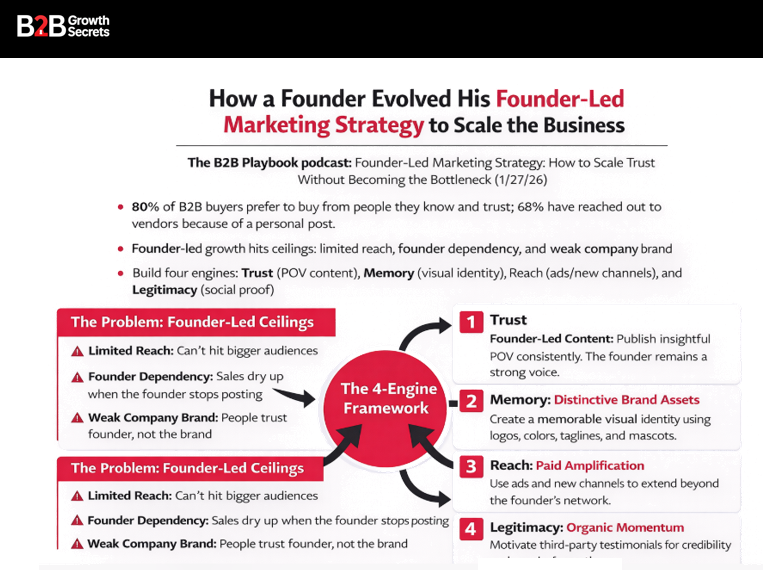
Founder-led growth hits ceilings: limited reach, founder dependency, and weak company brand
Build four engines: Trust (POV content), Memory (visual identity), Reach (ads/new channels), and Legitimacy (social proof)
Adam Holmgren, CEO of Fibbler, shares his framework for evolving from founder-driven growth to a scalable company brand, complete with a pink lion mascot that's taken over LinkedIn.
The case for founder-led (first)
The stats are clear: 80% of B2B buyers prefer buying from people they know and trust. 68% have reached out to vendors because of a personal post. With 200,000+ SaaS companies competing (up from 30,000 in 2024), your strongest lever is yourself – your expertise, your network, what makes you unique.
Adam started posting on LinkedIn 3 years before launching Fibbler. When they finally had a product, he had 30,000 connections who trusted him. Result: 50 paying customers in the first four months. "That would never have happened without my network."
The three ceilings founders hit
But then it stopped scaling. Adam identified three ceilings:
Reach (LinkedIn algorithm limits, geographic constraints)
Dependency (if he stopped posting, pipeline dried up)
Brand ceiling (people knew Adam, not Fibbler)
The mistake is thinking founder-led alone will take you to the moon. It won't. It's the launch vehicle, not the destination.
The 4-engine framework (with tactics)
Adam developed a comprehensive framework with 4 engines that work together. Here's how each one operates:
Engine 1: Trust (Founder-led content)
This is your foundation. Adam recommends setting up clear weekly content pillars – three to four topics you rotate through consistently. His pillars: LinkedIn ads, building in public, brand building, and ABM/attribution.
The critical rule: your pillars should be adjacent to your product, not about your product. Adam has a LinkedIn ads product, so he posts about running LinkedIn ads effectively. That's not pitching – it's giving value in a related space. "If you start pitching your product, people will unfollow you. That will never work."
Strong founder POV is non-negotiable. Adam points to creators like Adam Robinson who have "extremely strong points of view" as examples. Being authentic matters more than being polished. Share when you know things, but also when you don't.
Engine 2: Memory (Distinctive brand assets)
Here's Adam's key insight: thought leader ads built trust, but they didn't build brand. "They look and feel like me. There's no branded elements. It didn't build brand at all."
The solution: add distinctive brand assets to everything. This could be a mascot (their pink lion), your logo, specific colors, or a visual style… anything people can instantly recognize while scrolling.
Adam took this further with "meme-branded content" – taking popular meme formats and inserting their mascot into them with relatable situations (like executives hunting you down for ROI). This makes content both engaging AND memorable. "You can never brand something too much. People need to know the sender."
Engine 3: Reach (Paid amplification)
Organic reach has limits. Adam's network skewed European, but he wanted US customers. The solution: thought leader ads.
The playbook: take your best-performing organic posts, add branded visual assets, then sponsor them to audiences outside your network. Adam reports CTRs of 10-20% on thought leader ads versus 0.04% for regular ads. Today, 50-60% of Fibbler's customers come from the US, largely attributed to this amplification strategy.
The key is that you need great organic content first. Thought leader ads are "the most underutilized, most powerful format that exists, but they require so much from you in terms of content."
Engine 4: Legitimacy (Organic momentum)
This is the hardest engine but potentially the most powerful: getting other people to talk about you.
Adam's approach starts with product design. Fibbler built shareability into the product itself – dashboards have a screenshot button that automatically blurs sensitive information, making it easy for customers to post their results on LinkedIn. "It's impossible to force anyone to post about you. It has to come genuine. But you can make it easy for them."
The goal is authentic word-of-mouth: getting included in "tech stack" posts, community-driven content where users share experiences, and raw testimonials rather than polished case studies. "A real brand grows when other people are talking about it."
How the engines compound
The magic happens when all four engines work together. Founder content builds trust. Brand assets make that content memorable. Paid amplifies reach beyond organic limits. And legitimacy from third-party voices compounds everything.
The bottom line
Start with founder-led content – there's no faster path to initial traction. But plan for the transition. Build a distinctive visual identity early. Create systems so marketing continues without you posting daily. The goal is a brand people remember even when they're not ready to buy, so when they are ready, you're the obvious choice.
Disclaimer
B2B Growth Secrets summarizes and comments on publicly available podcasts for educational and informational purposes only. It is not legal, financial, or investment advice; please consult qualified professionals before acting. We attribute brands and podcast titles only to identify the source; such nominative use is consistent with trademark fair-use principles. Limited quotations and references are used for commentary and news reporting under U.S. fair-use doctrine.
