
Stop selling your company. Start selling the problem.
Welcome to B2B Growth Secrets, where every week, we listen to dozens of B2B Growth podcasts and extract the top actionable ideas.
In this issue:
The #1 demand-gen tactic is to build “microsites” that speak about the problem you solve, not your company
Three demand gen tactics by the former SVP of Strategy at Marketo (#1 is the “microsites” strategy)
PLG vs SLG: Match your growth model to how well your customers understand their own problem
1. The #1 demand-gen tactic is to build “microsites” that speak about the problem you solve, not your company
Unstoppable podcast: 3 Proven B2B Demand Generation Strategies to Increase Leads (1/25/26)
TLDR:
Create microsites around the problem you solve (not your company name) to capture SEO and AI search traffic
The problem with outbound isn’t the email script – distribution and list quality are 99% of the problem!
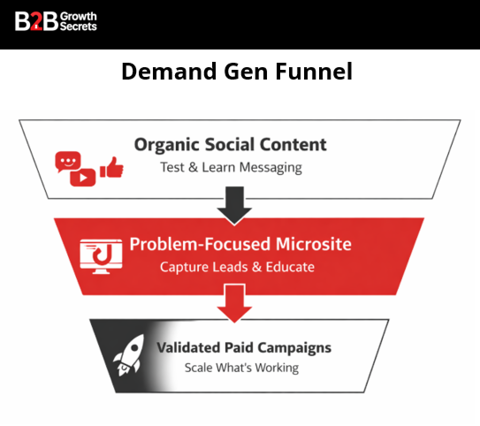
Start with organic middle-of-funnel social content, then build microsites, then scale with paid ads
TK Kader, former SVP of Strategy at Marketo during its $4.75B exit to Adobe, shared 3 demand generation strategies he's used across hundreds of B2B SaaS companies. The most surprising? A microsite he built years ago still generates leads today, even though the SSL certificate expired and nobody maintains it.
Why microsites work when company websites don't
The strategy is simple: buy a domain that describes the problem you solve, not your company name. Create in-depth educational content that ranks in search engines and gets cited by AI tools like ChatGPT and Gemini. Then link that content to your lead magnet and main website.
When TK was at ToutApp (which became Marketo), they bought spreadsheetcrm.com. Salespeople were searching for ways to track their own deals outside their company's CRM. The microsite offered a free spreadsheet template, captured leads, and nurtured them toward ToutApp's solution. Years later – through multiple acquisitions ending at Adobe – that domain still drives people to join their LinkedIn group.
The key insight: you're speaking to the problem, not your product. Someone searching "spreadsheet CRM" isn't looking for sales engagement software. But they're the exact right person to eventually buy it.
The 95/5 rule that explains why most marketing fails
Here's why demand generation matters more than lead generation: only 5% of your target market is actively buying right now. The other 95% are somewhere on the journey. They might not know they have a problem, don't know solutions exist, or haven't heard of you yet.
If you only target active buyers (the 5%), you're competing with every other vendor on expensive paid keywords. Those clicks cost hundreds of dollars because everyone knows those searchers are ready to buy.
Demand gen flips the script. You reach the 95% early through education, build trust over time, and become the obvious choice when they're finally ready. That's why microsites focused on problems outperform landing pages focused on products.
How to sequence your demand gen investment
TK recommends this order:
Start posting middle-of-funnel organic content on whatever social platform your buyers use. This is lower risk and teaches you what messaging resonates.
Once you understand your audience, build a microsite around a core problem.
Then, take your best-performing organic content and turn it into paid campaigns to scale.
The mistake most companies make is skipping straight to paid ads without knowing what converts. You'll burn money testing messaging that organic content could have validated for free.
The bottom line
Your TikTok post dies in 24 hours. A well-built microsite – one that genuinely educates prospects about a problem – can generate leads for years. Buy the domain, create evergreen content, and let SEO and AI search do the work. Start with organic social to learn what resonates, then build the microsite, then scale with paid.
2. The problem with outbound isn’t the email script – distribution and list quality are 99% of the problem!
AIIM Growth Partners podcast: What Most Businesses Get Wrong About Sales (1/29/26)
TLDR:
The best email template is worthless if it never reaches an inbox or your call never gets answered
Focus on sharpening the axe (list building and channel optimization) before chopping down trees (perfecting scripts)
If you spend any time on LinkedIn, you've seen the posts: "Here's the ultimate cold email template" or "This opener doubled my reply rates." David Zeff, founder of Whistle and someone who's worked with 350+ B2B companies on outbound, has a contrarian take: that advice is solving the wrong problem.
The real bottleneck isn't your message
Here's David's breakdown: the messaging – what you say in emails, calls, and LinkedIn messages – represents maybe 1% of your outbound success. The other 99%? Finding the right person at the right company on a channel where they're actually reachable.
Think about it this way. You could craft the most personalized, research-backed email in the world. But if it lands in spam, gets filtered by a gatekeeper, or goes to someone who left the company six months ago, it doesn't matter. Your phone script might be perfect, but if nobody picks up because your data says "main line" instead of direct dial, you'll never get to deliver it.
Why people overcook their messaging
David sees founders and sales teams spend weeks perfecting their pitch while neglecting the fundamentals. They'll analyze the latest earnings report to personalize an email when a simple, clear message about one or two pain points would perform just as well – if it actually got delivered.
The social media advice ecosystem makes this worse. Script optimization is sexy content. "I spent 30 minutes researching each prospect" makes for good posts. But "I invested in better contact data" doesn't get the same engagement.
Where to actually focus your energy
There are only three channels for B2B outbound: email, phone, and LinkedIn.
Before you optimize what to say on each channel, ask whether you can even reach your prospects there. Are your emails getting delivered? Are your phone numbers accurate? Are your LinkedIn connection requests going through?
The fix is unsexy but effective: invest heavily in list quality and contact data. Build tight prospect lists based on your ideal customer profile. Verify email deliverability. Get direct phone numbers, not switchboards. Test your LinkedIn outreach limits.
Once you've solved channel access, your messaging can be simple. Touch on one or two things someone in that role at that type of company cares about. That's it. No need to over-engineer.
The bottom line
Stop obsessing over email templates and call scripts. The tree-falling-in-the-forest analogy applies perfectly: if you write the ultimate personalized message but connect with zero people today, it doesn't count. Spend most of your time sharpening the axe – building accurate lists and ensuring channel access – and a fraction on the actual chopping.
3. PLG vs SLG: Match your growth model to how well your customers understand their own problem
Spotlight on B2B Marketing podcast: The Truth About Product Led Growth Strategy (with Gary Gonsalvez) (1/27/26)
TLDR:
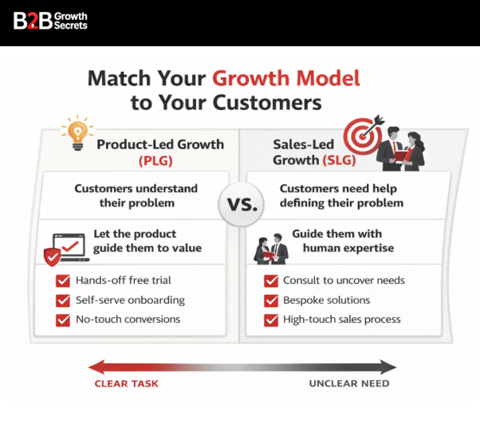
PLG works when customers have a clear task to accomplish; sales-led works when they need help defining the problem
In PLG, marketing owns the entire customer journey – there's no sales team to hand off to
Master one model through obsessive customer focus before attempting a hybrid approach
Gary has spent 20 years delivering 10x growth across both product-led and sales-led companies. His insight: the choice between these models isn't about your preference or capability; it's about how well your customers understand their own problem.
The fundamental difference is who does the educating
In product-led growth, the product experience itself guides customers through understanding their problem, evaluating solutions, and recognizing value. Every touchpoint – signup form, first login, dashboard, onboarding – must move users toward conversion without human intervention.
In sales-led growth, human expertise bridges the gap between where customers are and where they need to be. Salespeople help prospects understand what good looks like, align stakeholders, and navigate complexity that can't be self-served.
The question isn't which model is better. It's which model matches what your customers actually need.
When each model fits
Gary frames it around customer task clarity. At Pledge, where he worked in a PLG role, sustainability managers had a clear urgent task: "I need to produce an ESG report for the board in 6 weeks." They could evaluate whether the platform helped them complete that task through a trial. The customer journey was predictable.
At risk management companies using sales-led models, customers say something different: "I think we need better risk management, but I don't know where to start." No product trial can solve that level of uncertainty. They need consultation to understand the problem before they can evaluate solutions.
If your customers know what task they're trying to accomplish, PLG can work. If they need help defining the problem itself, you need sales-led.
The skill set differences are real
Gary was hired specifically because he wanted to learn PLG after years in sales-led environments. The transition was harder than expected because the skill sets are fundamentally different.
In PLG, marketing owns the entire go-to-market. There's no sales team to hand off to. You must track every data point, test every conversion step, and iterate daily. Support tickets become product intelligence. Every confused user represents a conversion killer that needs fixing.
In sales-led, you're orchestrating relationships across multiple teams with longer feedback loops. Quarterly pivots replace daily iterations. The focus shifts from product experience optimization to sophisticated relationship management.
Hiring managers know this, which is why they're often fanatical about wanting PLG experience for PLG roles. The skills genuinely don't transfer automatically.
The bottom line
Don't choose a growth model based on what's trendy or what your team knows. Choose based on your customer's task clarity. If they can evaluate your solution themselves, invest in PLG. If they need help understanding the problem, invest in sales.
Disclaimer
B2B Growth Secrets summarizes and comments on publicly available podcasts for educational and informational purposes only. It is not legal, financial, or investment advice; please consult qualified professionals before acting. We attribute brands and podcast titles only to identify the source; such nominative use is consistent with trademark fair-use principles. Limited quotations and references are used for commentary and news reporting under U.S. fair-use doctrine.
