
He shut down a 7-figure agency and built a $100M company
Hey, I’m KP and wanted to thank you for joining the 50,000+ B2B growth leaders reading my newsletter. Each week, my team and I listen to dozens of B2B growth podcasts and share the ideas that can make the biggest difference.
In this issue:
He shut down his 7-figure services business, bought the tech they were using, and turned a $1M business into a $100M valuation in 18 months
Podcast guesting is the new cold outreach, but for most people it’s a missed opportunity
To turn events into a revenue driver, each event should have a specific commercial purpose (top, mid, bottom funnel)
Tool of the week 🤔
I “Claude Coded” a daily task management app → Check it out at AskCato.app
Also recently heard the expression: “you need to find Claude-life balance” (that’s when I realized I’m just short of an addict and need to set rules to switch off).
If enough people are interested, I’ll host a workshop to show exactly how I built it and how you can code your own basic apps. Just reply back.
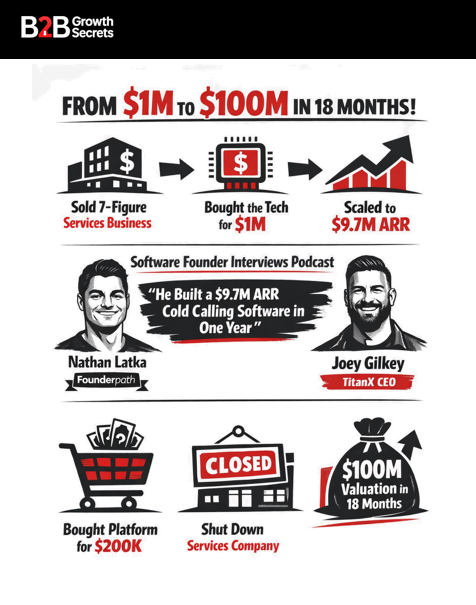
1. He shut down his 7-figure services business, bought the tech they were using, and turned a $1M business into a $100M valuation in 18 months
Software Founder Interviews podcast: “He Built a $9.7M ARR Cold Calling Software in One Year“ with Nathan Latka, CEO @ Founderpath, and guest Joey Gilkey, CEO @ TitanX [March 25, 2026]
Editor’s note: If you run a B2B services company, look through your tech stack to see if there are any tools that the market is sleeping on and you have ideas to optimize + scale, perhaps by selling to larger enterprises.
TLDR:
Joey Gilkey acquired a phone intent data platform for $200K cash in 2023 (+$800K seller’s note).
Shut down his seven-figure services business, and scaled TitanX to $9.7M ARR by early 2026.
Raised Series A at $100M valuation within 18 months!
The buy vs. build decision
In August 2023, Joey was running a seven-figure fractional sales development business. He'd been licensing a proprietary data set called "phone intent" data that predicts which phone numbers will actually be answered on a cold call. It was expensive and slow, but the results were undeniable.
Rather than waiting for someone else to build it better, Joey bought the underlying IP for $1M ($200K cash upfront and $800K on a seller note). His plan at first was to use it as a moat for his services business.
Within months, he realized the technology itself was the business.
He shut down the services company in early 2024. On June 1, 2024, TitanX took its first dollar.
Zero to $9.7M in under two years
The early PLG (product-led growth) model (users sign up and self-serve) didn't work. Joey killed it within two months and moved upmarket to enterprise. By the end of 2024, TitanX was at $1.4M ARR. By the end of 2025, $6M. By early 2026: $9.7M.
That last jump came from buying FrontSpin, a high-velocity dialing software, for $13M. FrontSpin contributes ~$2M of that ARR.
Joey structured the Series A ($27M raised at ~$100M valuation) so that $10M went to him as, while $7M went toward the acquisition. He gave up some equity but got his first liquidity event at the same time.
How they actually get customers
TitanX's GTM breaks down like this:
45% inbound organic (around 40 high-ACV meetings per month from the website)
38% outbound phone-only (they use their own product)
The rest from paid, referrals, and affiliates
They tier their pricing by team size:
3-10 reps at $24K/year
10-30 reps at $50K
30-50 reps at $90K
50+ reps at $250K
It's a credit-based consumption model: customers buy credits to run phone intelligence against their lists — which means the more they use it, the more they spend.
Gross retention sits at 92%. Net revenue retention (what you get after accounting for expansion) is 136%.
The expansion play: get into one team at $250K, then systematically expand to the other five or six teams within the same organization.
The bottom line
If proprietary technology already exists in your space and nobody has optimized it, buying it is often faster and cheaper than building it. He turned $1M into a $100M+ valued business in 18 months. Not because the idea was new, but because he owned the underlying asset and bet everything on it. The lesson isn't "go buy IP." It's: find the thing in your market that competitors are sleeping on, figure out how to control it, and go all in.
2. Podcast guesting is the new cold outreach, but for most people it’s a missed opportunity
Knack 4 Business podcast: “Podcast Guest Strategy That Actually Drives Revenue” with Carl Richards, founder @ Podcast Solutions Made Simple [March 25, 2026]
Editor’s note: I’m a big proponent of leveraging podcasts and newsletters as a way to build a loyal audience AND connect with high-value prospects by interviewing them. Hadn’t thought of it from the other side: guests get amazing exposure without having to build an audience!
TLDR:
Podcast guesting – appearing on other people's shows instead of hosting your own – is a lower-cost, faster path to building authority and reaching ideal clients.
But most guests show up without a clear problem statement, a strong point of view, or a specific call to action; that's the entire opportunity to stand out.
The before/during/after framework is what separates forgettable guests from ones who actually drive business.
Why podcast guesting is having a moment
Carl Richards spent 25 years in radio before pivoting to help businesses launch and grow podcasts. His firm, Podcast Solutions Made Simple, recently started offering a dedicated guesting service – and it filled fast.
The logic is straightforward. Social media algorithms are increasingly hostile to organic reach. Traditional media is shrinking. But podcasting audiences are loyal, niche, and growing.
As Carl puts it, getting on podcasts is the modern equivalent of a book tour or a speaker circuit, except it's accessible to anyone with a clear point of view and 30 minutes.
The catch: most podcast guests treat it like a favor to the host rather than a growth channel for themselves. They show up, talk about their background for 20 minutes, and go home without a clear takeaway or a way for listeners to follow up. That's a missed opportunity.
The before: strategy and preparation
Carl's agency doesn't just book shows; they help clients figure out what to say before they get on one. The key questions are:
What problem do you solve? (Not what do you do but what specific problem?)
What's your point of view? (What do you believe that most people in your industry don't?)
What's your call to action? (Something more specific than "visit my website")
They also personalize the outreach on the client's behalf, making it sound like it's coming directly from the guest, not from an agency. This means researching the show, understanding the host's audience, and pitching a specific angle rather than a generic bio.
The during: be of service, not of self
The most common mistake Carl sees: guests who treat the appearance as a platform for their own story rather than as a resource for the host's audience. The mindset shift that changes everything is: the audience is not there to learn about you. They're there to learn from you.
Practically, this means keeping answers focused and tight. Don't ramble. Don't take the host's single question as an invitation to deliver a 15-minute monologue.
Carl's rule from radio: whoever holds the mic controls the room. Give the host room to drive.
The after: where most guests drop the ball
When the episode goes live, the guest's job isn't over. Carl coaches clients to:
like and comment on anything the host shares,
create their own posts with the episode link, and
share any audiograms or video clips the host provides.
This signals to the host that you're a good partner, which leads to referrals to other shows.
The full cycle – strategic pitch, focused appearance, active promotion – is what separates a one-time appearance from a compounding distribution channel.
The bottom line
If you're trying to build credibility with a specific audience but not ready to launch your own show, podcast guesting is the most efficient path available right now. The bar is low because most guests don't prepare. Show up with a sharp point of view, a specific call to action, and a commitment to promote the episode, and you'll stand out in the first appearance.
3. To turn events into a revenue driver, each event should have a specific commercial purpose (top, mid, bottom funnel)
B2B Growth podcast by xGrowth: “How to Turn B2B Events into a Genuine Revenue Lever” with Shahin Hoda, founder @ xGrowth, and guest Jannat Dawra, Head of Marketing APAC @ Dotdigital [March 25, 2026]
Editor’s note: I’m organizing a series of in-person events now (check out Compound Growth) and found Jannat’s framework very helpful to think very specifically who will attend, and what content will resonate with them so there’s no misalignment.
TLDR:
Every event you run should map to one of three jobs: generate new pipeline (top of funnel), accelerate deals already in motion (mid-funnel), or retain and expand existing customers (post-sale).
A $10K event isn't just $10K: it's $10K plus your team's time and cognitive load. Factoring in opportunity cost changes which events you'd actually run.
The biggest event mistake isn't low attendance; it's creating content for the wrong seniority level and filling your room with people who can't make the buying decision.
Three types of events, three distinct jobs
Jannat organizes her entire events program around three buckets, each with a specific commercial purpose.
Industry conferences (sponsor + booth + speaking) are top-of-funnel. Brand positioning, first impressions, and getting clients to tell your story publicly. You're not closing deals here. You're earning a place on shortlists.
Partner events are mid-funnel relationship plays. Find companies with a similar ICP (ideal customer profile) who aren't direct competitors, co-host a roundtable or dinner (20–30 people), and invite a mix of your respective clients and prospects. Because both companies are drawing from different networks, everyone meets people they wouldn't otherwise encounter. The “sell” is soft. The relationship value is high.
Owned events are where the real leverage lives, and they break into two distinct formats.
Community events are for building advocates: bring in existing clients, create peer-to-peer conversations, no hard selling.
Prospect roundtables are for deals that are already in motion: show prospects what it actually looks like to work with you before they sign. Walk them through real use cases. Introduce them to the implementation team. Show them what their ROI would look like. You're not pitching anymore. You're making the purchase feel inevitable.
The three questions every event has to answer
Jannat describes her events approach as "commercial." She takes events seriously as revenue vehicles, not just brand-building activities. Before any event gets planned, it has to answer at least one of three questions:
Does this add genuine value for the ICP we've defined, and will they leave knowing something useful?
Does it accelerate a deal that's already in our pipeline?
Does it strengthen retention or create expansion opportunities with existing customers?
If the answer to all three is "not really," the event doesn't happen. This filter alone would eliminate a significant portion of the events most marketing teams default to running.
The opportunity cost math
A $10K event is never just $10K. It's the budget, plus the hours of planning from your team, plus the sales team's time preparing and attending, plus the follow-up cycle after. That's the true cost. And the true cost needs to be weighed against what else that budget and effort could have produced.
This forces honest prioritization. Instead of asking "should we do this event?" the better question becomes "is this the highest-value thing we could do with this investment right now?" Sometimes it is. Often it isn't.
Build a flex plan, not a fixed calendar
Jannat builds a quarterly events calendar at the start of each year but deliberately leaves it flexible. The specific mix shifts based on where the business needs support.
If pipeline is down, she doubles down on top-of-funnel conferences to generate new opportunities.
If churn is elevated, she shifts to community and client events.
If the sales team is under end-of-year pressure to close deals, she pulls back on events that require heavy sales involvement and runs conferences instead where the team just needs to show up.
She checks in quarterly with sales, CS, and partnership leads – not for sign-off, but to read where the pressure is and adjust accordingly.
The other thing she watches: sales fatigue. If the team has been inviting prospects to events for three months straight, they're burnt out on it. And burnt-out invitations produce low attendance. She reads that signal and gives them breathing room.
The mistake that fills your room with the wrong people
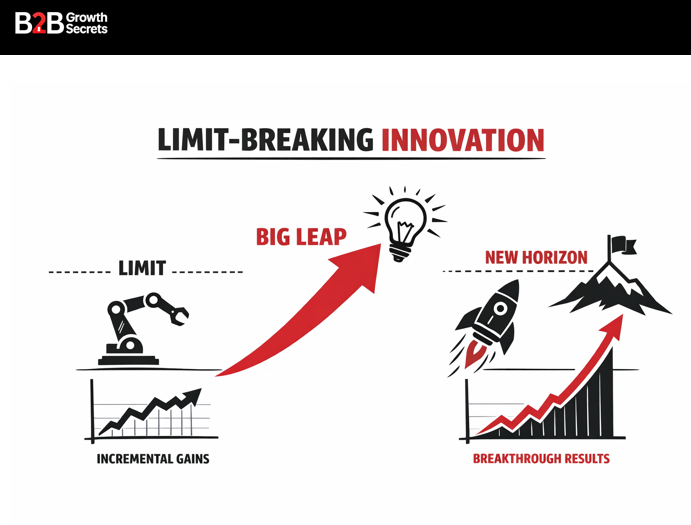
Jannat’s biggest early-career event failure: she created content targeted at end users – the people who would actually use the product day-to-day. The event was well-attended. But the room was full of junior people who had no buying authority.
Her rule now: before any event, she gets clear on exactly who should be in the room and builds the content around what would be valuable to that specific seniority level.
Executives want ROI and strategic vision.
Practitioners want implementation depth and peer-to-peer comparison.
These are different events. Running the wrong one for the wrong audience is how you spend real money on a room full of people who can't sign the contract.
The bottom line
Events are expensive in time and budget, which means they need to earn their place on your calendar the same way any other revenue investment does. If you can't articulate which pipeline stage an event serves before you plan it, you're not ready to plan it. Define the commercial goal first, build the content for the right audience second, factor in the real opportunity cost third… and only then start booking venues.
Disclaimer
B2B Growth Secrets summarizes and comments on publicly available podcasts for educational and informational purposes only. It is not legal, financial, or investment advice; please consult qualified professionals before acting. We attribute brands and podcast titles only to identify the source; such nominative use is consistent with trademark fair-use principles. Limited quotations and references are used for commentary and news reporting under U.S. fair-use doctrine.
