
Predictable Revenue is dead, here’s the outbound playbook for 2026
In this issue:
The “predictable revenue” playbook is broken (and what to do instead)
Generic positioning is killing your growth
From transactional to strategic networking
1. The “predictable revenue” playbook is broken (and what to do instead)
The B2B Playbook podcast, Episode: Outbound Sales Strategy 2026: The Evolution of Predictable Revenue and What Works Now (Nov. 9, 2025)
TLDR:
The Predictable Revenue model that powered SaaS growth for a decade has broken because volume-based SDR prospecting burns bridges and overwhelms buyers with generic outreach
The future is “long-term nurture”: reaching out 3–9 months before buyers are in-market, staying in touch with value, and building relationships over time instead of pushing for immediate meetings
Modern outbound requires commercial system alignment: marketing, SDRs, AEs, and customer success all working together to create demand, not just capture it
The Predictable Revenue playbook changed SaaS sales forever. Aaron Ross's book gave every company a blueprint: hire SDRs, send cold emails at scale, book meetings, hand them to AEs, close deals. Simple. Repeatable. Scalable.
Then it stopped working. Colin Stewart, CEO of Predictable Revenue and author of "The Terrifying Art of Finding Customers," explains why the model broke… and what comes next.
How “predictable revenue” became a volume game
When Aaron Ross built Salesforce's first SDR team in 2005–2006, the tactics were relatively novel. Cold outreach wasn't yet saturated. Buyers didn't receive 47 near-identical cold emails every week.
But as the playbook spread, every SaaS company copied it. Suddenly, buyers were drowning in generic, automated prospecting messages. The tactics that worked in 2006 became table stakes by 2015 and actively annoying by 2020.
Companies doubled down on volume. If 1% of cold emails get responses, send 10x more emails! This created a race to the bottom where SDRs became glorified spam machines, burning through lists as fast as possible.
Colin saw this firsthand. SDRs would get prospects on the phone, qualify them as fitting the ideal customer profile, then hand them off to AEs, only to have the AE say "they're not ready to buy in the next 90 days, so I don't want to talk to them."

The shift to long-term nurture
Colin's insight: stop trying to force immediate meetings. Instead, identify good-fit prospects early – before they're actively shopping – and stay in touch over time with genuinely useful content and insights.
This means your SDRs aren't just booking meetings. They're building relationships. They might have 5–10 touchpoints with a prospect over 6 months before that person is ready to take a demo.
Here's what that looks like in practice:
An SDR identifies a director at a growing SaaS company who matches your ICP.
They send a personalized note mentioning something specific about the company's recent product launch. No pitch. Just a genuine observation and an offer to share a relevant resource.
Over the next few months, the SDR:
shares a case study
invites them to a webinar
comments on their LinkedIn posts
sends a thoughtful article
When the prospect enters the buying window 4 months later, guess who they call first?
This approach requires patience. It requires SDRs to be intelligent, thoughtful, and capable of having real conversations – not just reading scripts. But it works because it aligns with how B2B buyers actually make decisions.
2. Generic positioning is killing your growth
B2B Marketers on a Mission podcast by EINBLICK Consulting, Episode: How to Leverage Storytelling for B2B Marketing Success (Nov. 12, 2025)
TLDR:
B2B companies commoditize themselves by using generic industry labels like "we do marketing" or "we sell insurance", causing prospects to immediately categorize and dismiss them
Specialization lets you sidestep commodity status by speaking to a specific audience that sees you as the only logical choice, not one of many options
The key isn't picking a niche randomly – it's identifying the audience you're most passionate about helping and that values your expertise most, then building your positioning entirely around them
Matthew Pollard, known as the Rapid Growth Guy, has transformed thousands of struggling businesses by teaching them one core principle: stop trying to serve everyone because you end up sounding generic.
Why generic positioning kills deals before they start
Matthew worked with an insurance advisor named Nick who went to networking events religiously. Nick did his research, asked good questions, and genuinely tried to help people. But whenever someone asked what he did, he'd say "I'm in insurance."
Instant shutdown. People's eyes would glaze over. They'd immediately think "here comes a sales pitch" and look for an exit.
The problem wasn't Nick's skills or his product. The problem was that "insurance" is a commodity. Everyone knows what insurance is. They already have it or already decided they don't want to talk about it. By leading with the commodity category, Nick eliminated any chance of a meaningful conversation.
The specialization unlock
Matthew pushed Nick to stop saying "insurance." Instead, he asked: "Who do you most want to work with? If you could only serve one type of client forever, who would it be?"
Nick initially resisted. "I want to help everyone." But when Matthew pressed him – would you rather work with someone earning $50K or $250K? – Nick admitted the higher earner was more attractive.
Then Matthew went deeper. Of two people earning $250K, one is a corporate executive who climbed the ladder through education and credentials. The other is a small business owner who built something from scratch. Which one do you connect with more?
Nick immediately said the entrepreneur. Why? Because his grandfather owned a farm and faced the cash flow challenges small business owners deal with. Nick had an emotional connection to that audience. He understood their pain points intuitively.
That's the key: don't pick a niche because it's lucrative. Pick the niche you're most passionate about serving and that values your specific expertise.
How to position for specialization
Once Nick identified small business owners as his focus, everything changed. Instead of "I'm in insurance," his intro became: "I help small business owners protect their cash flow so a single disaster doesn't wipe out years of hard work."
Suddenly, the right people leaned in. Small business owners who'd worried about this exact problem wanted to know more. Everyone else politely moved on – but that's perfect. Nick didn't want to waste time on bad-fit prospects anyway.
The specialization did three things:
Communicated value: Nick wasn't selling a commodity product; he was solving a specific, painful problem for a defined audience.
Eliminated price shopping: When you're specialized, you're not competing on price because prospects see you as the only logical choice, not one of many interchangeable options.
Made referrals easier: People could clearly identify who Nick helped and introduce him to relevant contacts. "You should talk to Nick—he helps small business owners protect their cash flow" is way more actionable than "Nick does insurance."
Building expertise in your specialization
Once you pick your niche, double down on understanding that audience better than anyone else. Read what they read. Attend their conferences. Learn their language.
For Nick, this meant understanding small business financial cycles, common cash flow crises, and the specific insurance gaps that put businesses at risk. He became known as the go-to expert for entrepreneurs – not because he knew more about insurance in general, but because he understood small business owners' specific needs better than anyone.
This creates a flywheel:
The more focused you are, the more expertise you build.
The more expertise you build, the more valuable you become to that audience.
The more valuable you become, the more they refer you to similar businesses.
3. From transactional to strategic networking
Knack4Business podcast, Episode: 5 SMART NETWORKING Strategies to BOOST Your Business Profits (Nov. 16, 2025)
TLDR:
Strategic networking focuses on building genuine relationships with the right people, not collecting hundreds of business cards at generic events
The key is identifying 5–10 high-value connections in your target market and investing time in deepening those relationships rather than spreading yourself thin across dozens of surface-level contacts
Effective follow-up, providing value before asking for anything, and consistency over time are what separate networking that drives revenue from networking that wastes time
Most B2B founders and growth leaders treat networking as a numbers game. Attend events, collect business cards, add people on LinkedIn, send connection requests. The more people you meet, the better, right?
Wrong. That approach leads to a database full of weak connections who don't remember you and won't refer business your way.
Quality over quantity in relationship building
The smart networking approach is radically different: identify 5–10 people in your target market who are well-connected, well-respected, and aligned with the types of customers you want. Then invest real time in building genuine relationships with those specific people.
This means:
Having regular coffee meetings or calls where you're not pitching anything
Sharing valuable insights or introductions that help them
Learning about their goals and challenges
Staying top-of-mind through consistent, thoughtful touchpoints
Providing value before asking for anything
The biggest networking mistake is treating every interaction as a sales opportunity. You meet someone, pitch your services within 5 minutes, and ask if they need what you're selling.
This creates transactional relationships. The other person feels used, not helped.
Instead, lead with value. What can you offer that helps them succeed? Maybe it's:
An introduction to someone in your network they'd benefit from knowing
Feedback on a project they're working on
A case study showing how another company solved a problem they have
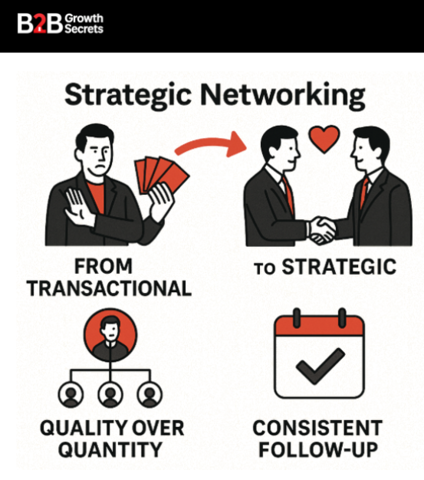
The follow-up framework that keeps relationships warm
Most networking fails at follow-up. You have a great conversation at an event, exchange cards, then... nothing. A few months later, you vaguely remember meeting them but can't recall what you talked about.
Smart follow-up happens within 24 hours of meeting someone. Send a personal note referencing something specific from your conversation. Not "great meeting you" but something like "Really enjoyed hearing about your expansion into the European market. Here's a GDPR expert I know and can put you in touch with."
Then, create a system to stay in touch regularly without being annoying. This might look like:
Quarterly check-ins where you share a relevant update or resource
Inviting them to events or webinars you think they'd find valuable
Commenting thoughtfully on their LinkedIn posts
Sending a message when you see news about their company
The key is consistency without being pushy. You're staying on their radar so when they or someone they know needs what you offer, you're the obvious call.
Disclaimer
B2B Growth Secrets summarizes and comments on publicly available podcasts for educational and informational purposes only. It is not legal, financial, or investment advice; please consult qualified professionals before acting. We attribute brands and podcast titles only to identify the source; such nominative use is consistent with trademark fair-use principles. Limited quotations and references are used for commentary and news reporting under U.S. fair-use doctrine.
