
Why your outbound fails, your org moves slow, and your podcast isn’t working
Welcome to B2B Growth Secrets, where every week, we listen to dozens of B2B Growth podcasts and extract the top actionable ideas. (For more context on these ideas, give the podcasts a listen)
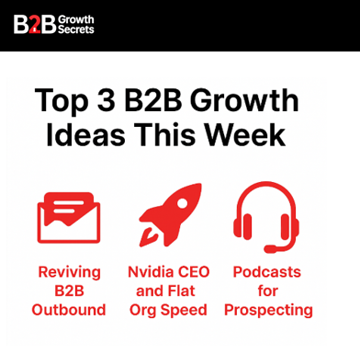
In this issue:
The “predictable revenue” playbook is broken (and what to do instead)
Generic positioning is killing your growth
From transactional to strategic networking
1. How to get your B2B outbound working again
Inside Marketing podcast by MarketSurge, Episode: The Brutal Truth About B2B Email, Sales Teams & AI: Kevin Downey Tells All (Nov. 21, 2025)
TLDR:
B2B cold email should emulate a cold call, not a newsletter.
Send thousands daily using Apollo or server-based systems like Mail Reef to generate consistent leads.
AI will handle simple yes/no qualification, but dynamic sales conversations still require humans.
Kevin Downey has sent over 100 million B2B emails across 8 years of client work. His diagnosis of why most cold email fails is: companies are marketing to people when they should be driving responses.
The fundamental email philosophy problem
Most companies run email through their CRM or use newsletter-style HTML emails via Constant Contact, Mailchimp, or HubSpot. These are fine for branding but won't generate leads day-to-day. The two core problems: volume limitations (you can't send enough through traditional CRM infrastructure) and the wrong approach (traditional sequences that market rather than engage).
Kevin's breakthrough came when he transcribed what an effective cold call actually sounds like, then structured his emails the same way. A cold call doesn't start by mentioning a blog post you read about the prospect. It identifies a pain point and asks a simple question. Your email should do the same.
The specific infrastructure that works
For brute force effectiveness, Kevin recommends the Apollo email API combination. You can send up to 6,000 emails daily from a single domain and email address. Yes, you'll get some blockage – reputation with Google Workspace is hard to maintain at that volume. But it's a numbers game.
For long-term sustainable infrastructure, the combination of Mail Reef (a server-based system) and Smartlead works better. The setup involves 20 domains, 100 email addresses, 25 cold emails per day and 25 warm emails per day per address. Spin texting, IP reputation management, and other technical details matter here. It's more complex and more expensive, but you can actually maintain your reputation over time.
Personalization is overrated
Here's a counterintuitive insight: excessive personalization often masks bad email copy structure. Kevin's team uses first name only, occasionally last name, and rarely company name (because if the data pulls the legal entity instead of the DBA, you look foolish). Think about how you'd actually write an email to introduce yourself to someone. You wouldn't mention an article about them or a blog post they wrote. Keep it simple.
AI won't replace dynamic sales conversations
AI can definitely handle simple front-end qualification – asking a basic question and getting a yes/no response. For example, a restaurant asking businesses if they'd like to see an updated catering menu.
But dynamic sales conversations involving conceptual selling? That last 5-25% of human capability is incredibly hard to replicate. Fully scripted reps have the same limitation. They can only ask one or two simple questions effectively.
The bottom line
Response rates vary dramatically by audience and pitch. On 6,000 daily emails, some campaigns barely generate a lead per day. Others consistently produce 15-20 leads daily. The difference comes down to pitch quality and audience fit.
Most companies Kevin reviews (250-300 setups over eight years) are doing it wrong. Only two or three were genuinely good, usually built by founders who learned the hard way.
If your B2B email isn't working, you probably have both a volume problem and a philosophy problem.
2. How Nvidia’s CEO operates a flat organization laser-focused on speed
Founders podcast, Episode: How Jensen Works (Oct. 19, 2025)
TLDR:
Flatten your org chart to increase the speed of information flow.
Replace 1-on-1s with public feedback so the whole team learns at once.
Plan projects based on the "Speed of Light" (the fastest possible completion time).
The "Speed of Light" Standard
Jensen Huang, CEO of Nvidia, believes that the biggest threat to a company isn't competition, but internal complacency.
To fight this, he demands his teams to plan based on the "Speed of Light":
When scoping a project, they calculate the absolute minimum time required if there were zero delays, no meetings, and perfect execution.
Then, they measure their actual performance against this “optimal performance” rather than against competitors or last year's results.
Public Criticism over Private Coaching
Standard management advice says, "Praise in public, criticize in private." Jensen disagrees. He believes that if someone makes a mistake, hiding it in a private 1-on-1 robs the rest of the organization of a learning opportunity.
He gives direct, sometimes harsh feedback in open meetings. The goal isn't to embarrass the employee, but to "refine the character of the company.”
He wants everyone to understand the standard of excellence required. If one person has a design flaw, everyone needs to know how to spot it next time.
The Flat Structure
Jensen has 60 direct reports and refuses to hire a COO. In most companies, information gets filtered and sanitized as it moves up through layers of management. By the time it hits the CEO, it's often useless.
By having 60 reports and avoiding private meetings, Jensen ensures he gets raw "information from the edge".
He uses a "Top 5" email system where employees send a list of the top five things they are working on. He reads about 100 of these every morning to keep a pulse on the company without bureaucratic filters.
The Bottom Line
Speed comes from removing layers. If you want your organization to move faster, stop shielding people from the truth and stop filtering information through middle management.
3. Use podcasts to build relationships with prospects, and stop worrying about vanity metrics
Localization Fireside Chat podcast with Robin Ayoub, Episode: Conversations Create Sales Pipeline with Bernie Franzgrote from Kreativ Insight (Nov. 10, 2025)
TLDR:
Use podcasts to build relationships with prospects, not just to get downloads.
Facilitate "self-sourcing" introductions where guests solve each other's problems.
Use a disciplined workflow to repurpose one recording into a week’s worth of content.
Many B2B founders launch podcasts hoping to become the next viral sensation. A more effective strategy is to use the podcast as a business development engine, where the primary value comes from the relationships you build with guests, not the audience size.
Conversations Create Pipeline
Bernie Franzgrote, host of The Knack for Business podcast, notes that the podcast is primarily a vehicle for discovery. By spending an hour deep-diving with a guest, you uncover their specific pain points and needs – insights you would never get in a standard sales pitch.
This leads to "self-sourcing" opportunities. For example, during a networking conversation, a commercial HVAC specialist met a business owner needing commercial balancing – a connection that happened naturally because the environment was about sharing stories, not pitching services. The podcast episode is simply the asset that solidifies that relationship and gives you a reason to stay in touch.
The "One-to-Many" Content Workflow
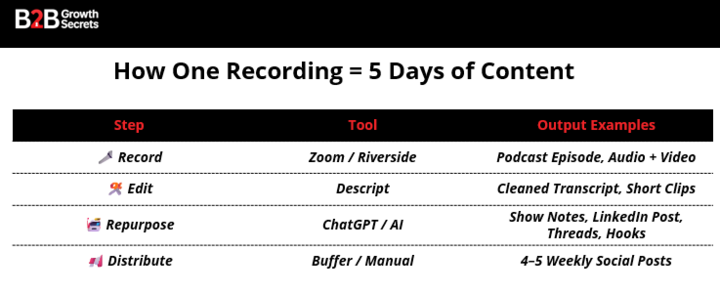
Consistency is the hardest part of podcasting. Franzgrote uses a specific stack to turn one conversation into multiple assets without burnout.
Recording: Focus on a natural conversation to put the guest at ease.
Editing: Use tools like Descript to edit text and audio simultaneously.
AI Integration: Feed the transcript into an AI tool with a specific prompt: "You are [Role], here is the transcript. Create show notes, YouTube descriptions, and social posts".
Distribution: This generates enough snippets and notes to post content 4-5 times a week from a single recording.
The Bottom Line
If you are a B2B founder with a podcast, don't worry about download numbers. Measure your podcast's success by the number of guests who turn into partners, clients, or referral sources.
Disclaimer
B2B Growth Secrets summarizes and comments on publicly available podcasts for educational and informational purposes only. It is not legal, financial, or investment advice; please consult qualified professionals before acting. We attribute brands and podcast titles only to identify the source; such nominative use is consistent with trademark fair-use principles. Limited quotations and references are used for commentary and news reporting under U.S. fair-use doctrine.
