
Most Growth Experiments Should Fail
Hey, I’m KP and wanted to thank you for joining the 35,000+ B2B growth leaders reading my weekly newsletter. Each week, my team and I listen to dozens of B2B growth podcasts and share the ideas that can make the biggest difference.
In this issue:
The best growth teams operate like VCs: run tons of experiments knowing most will fail, and debug the ones that fail like code to learn from them
How to turn a B2B podcast into your most productive business development channel
How to think of owned events as an asset that compounds value over time
Thought of the week 🤔
a16z interviewed Kevin Weil (VP, OpenAI), who said "I just wasted an hour" b/c he entered a meeting and forgot to give instructions to Codex to run stuff for him.
That's the mindset shift you should be thinking about.
"What can AI do while I'm doing other stuff?" (showering, sleeping, meeting).
Ask your favorite LLM today (+Deep Research): how can I best use Claude Code [or Open Claw] to become more productive?
1. The best growth teams operate like VCs: run tons of experiments knowing most will fail, and debug the ones that fail like code to learn from them
The Evergrow Show, From Failures to $1B Exits: The B2B Growth Secrets of The Top 1% w/ Guillaume Cabane (2/24/26)
TLDR:
The best growth teams operate like VCs: they run tons of experiments knowing most will fail, because the few that work create outsized returns.
When a channel "isn't working," don't kill it: debug it like code by isolating whether the problem is your audience, messaging, or tech stack.
Guillaume "G" Cabane has built growth engines at companies like Drift, Segment, Ramp, and Reddit. His philosophy sounds counterintuitive: he targets a 70% failure rate on experiments.
If all your experiments succeed, you're just catching up
Guillaume frames growth like venture capital. A good VC doesn't know which startup will win – they invest broadly and let the winners pay for the losers. Growth works the same way. If every experiment you run is succeeding, it means your ideas are obvious, and your competitors are already doing them. Real moats come from trying things that feel too risky, too weird, or too hard for others to copy. The alpha lives in the non-obvious.
Debug failures like an engineer, not a marketer
At Ramp, direct mail failed three times. The team concluded the channel was dead. Guillaume pushed back: if American Express makes money with direct mail, the channel isn't broken, something else is.
At another company, outbound reply rates were terrible. Instead of scrapping the campaign, he ran a creative diagnostic: they sent an unrelated email mentioning a gift was being shipped, but deliberately listed a slightly wrong office address. People replied to correct the address at a very high rate. That proved the tech stack and audience were fine. The problem was the product messaging.
By isolating variables like a scientist, you figure out what to fix instead of throwing the whole channel away.
The Reddit playbook: show, don't tell
When Reddit needed to grow its self-serve ad platform, Guillaume didn't spray and pray. He scraped the Facebook Ads Library to identify companies that were maxing out their Facebook budget. Then he analyzed their ads to infer their audience, product, and best-fit Reddit communities, and reached out with a mock-up of what their Reddit ads could look like.
The lesson: build your TAM list (most companies don't have one!), research prospects deeply, and deliver value upfront so your outreach triggers reciprocity, not irritation.

The bottom line
Growth isn't about finding the one magic channel. It's about running enough non-obvious experiments that you get lucky faster than your competitors. Debug failures instead of abandoning channels and embrace the idea that most of your bets should fail. That's where the alpha hides.
2. How to turn a B2B podcast into your most productive business development channel
Smart Business Revolution podcast, Mastering Podcast Production for Business Growth With John Corcoran (2/27/26)
TLDR:
A B2B podcast isn't a content play. It's a networking, business development, and personal brand engine all wrapped into one. Treat it that way and it replaces dozens of hours of traditional outreach.
Video podcasting is now table stakes (60-75% of B2B podcasts include video), and YouTube's role as the #2 search engine makes it an SEO goldmine.
The biggest mistake B2B podcasters make is getting pulled into production details. Your only job is to show up, build relationships, and hand everything else off.
John Corcoran has been running a B2B podcast for over 17 years and has produced 1,500+ episodes. His company helps B2B businesses launch and run podcasts.
It's a relationship tool, not a content tool
The biggest mindset shift Corcoran advocates: stop thinking of your podcast as content marketing. Think of it as a way to build relationships with prospective clients, referral partners, and industry leaders – all from your office.
You'd normally spend hours traveling to conferences, networking events, and dinners for these conversations. A podcast lets you have the same quality of interaction in 30-45 minutes over Zoom. For a B2B founder or growth leader, that time savings alone makes it worthwhile.
Always record on video, even if you don't publish it
About 60-75% of his clients now produce video podcasts, and for good reason. YouTube is the second largest search engine, Google loves to surface YouTube links, and video content is easily repurposed into short-form clips. But even if you're not ready to publish video, Corcoran insists you should still record interviews on camera. Why? It makes for better conversations. Guests are less likely to ramble when they can see your facial cues, and the face-to-face dynamic builds deeper rapport.
Thought leadership episodes fill the gaps
Beyond interviews, Corcoran recommends creating "thought leadership" episodes where you share your own expertise: answering FAQs, explaining your process, or talking about what makes your approach different. This matters because today, prospects Google you, search you on YouTube, look you up on Spotify and even ChatGPT. If they can't find anything, you're a ghost. These episodes create a searchable, shareable body of work that builds credibility before anyone ever gets on a sales call with you.
The bottom line
A B2B podcast works when you treat it as a business development system. Show up, have great conversations, build relationships, create short-form video clips to stay visible, and hand off every production detail to someone else.
3. How to think of owned events as an asset that compounds value over time
Events on Autopilot podcast, How Smart B2B Teams Turn Events Into a Growth Engine w/ Martin Fretwell, Founder of Event Driven Growth (2/25/26)
TLDR:
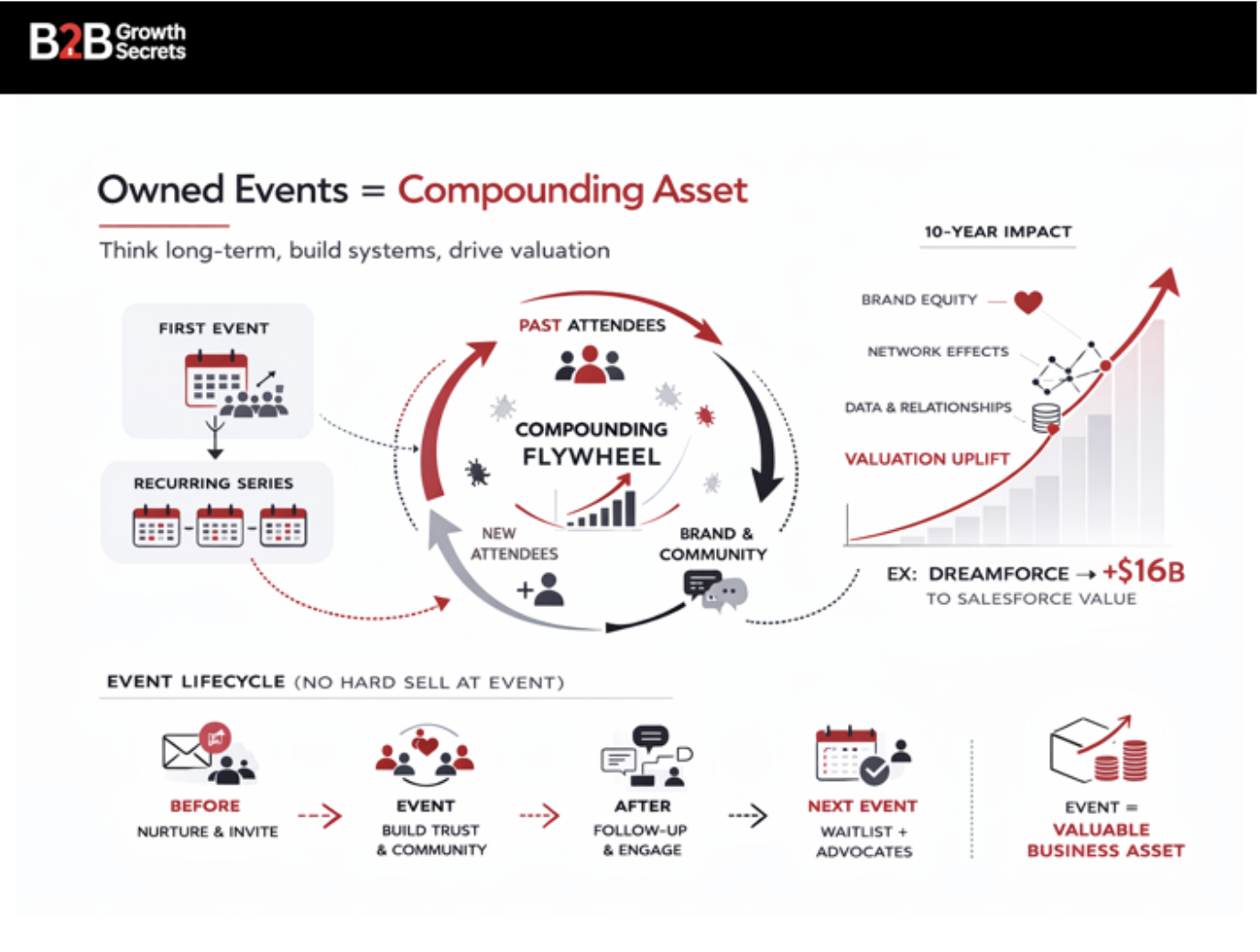
Most B2B teams treat events as one-off campaigns. The real ROI comes from building a recurring event series that compounds like a financial asset.
Owned events can dramatically increase your valuation. Dreamforce reportedly added $16B+ to Salesforce's shareholder value.
Don't sell at your events. Build trust systems around them so the selling happens naturally before and after.
Think of your event as an asset, not a campaign
Martin breaks event strategy into four pillars.
The asset mindset: your event is an asset that compounds brand and ROI over time, just like content or a customer base.
The compounding flywheel: each event gets easier because past attendees bring new ones.
Exit alignment: when a company gets acquired, acquirers aren't just buying revenue – they're buying assets. If you own the category event, that massively drives up your valuation.
Own the movement: Workhuman made their conference bigger than their own product. It's not about rewards and recognition software. It's about "better work." That makes even competitors' customers want to attend.
Why you shouldn't sell at your own event
The moment you start selling at an event, you signal that it's not a safe space. Attendees get skeptical. There's already growing cynicism around "free dinners" that are just pitch sessions.
Instead, build systems around the event – nurture sequences, follow-up engagement, clear next steps – so selling happens organically without poisoning the atmosphere of the event itself.
The bottom line
Stop asking "what can one event do?" and start asking "what could a recurring event series look like in 10 years?" The first event is always the hardest. But if you build systems that compound, you'll eventually have a waitlisted, category-defining gathering that's both a growth engine and a valuable business asset.
Disclaimer
B2B Growth Secrets summarizes and comments on publicly available podcasts for educational and informational purposes only. It is not legal, financial, or investment advice; please consult qualified professionals before acting. We attribute brands and podcast titles only to identify the source; such nominative use is consistent with trademark fair-use principles. Limited quotations and references are used for commentary and news reporting under U.S. fair-use doctrine.
