
Traditional sales is dead. Human intelligence isn’t.
Welcome to B2B Growth Secrets, where every week, we listen to dozens of B2B Growth podcasts and extract the top actionable ideas. (For more context on these ideas, give the podcasts a listen)
Learn AI from builders in B2B. We're launching AI Skills workshops to help you understand trends, build custom tools, and automate workflows (taught by the CTOs / Heads of AI building AI tools in your industry, not trainers).
Reply “Skills” to save your spot as a Founding Member (the first 100 get 50% lifetime discount).
In this issue:
AI has killed traditional sales channels! (and what actually still works)
Stop offering free POCs + it’s better to go bigger on fewer events
To stand out, highlight the risks in the buying decision… and how you address them
1. AI has killed traditional sales channels! (and what actually still works)
NextGen Sales Leaders podcast: What 10 Years of Enterprise Sales Teaches You About AI, RFPs, and Reality w/ Josh Gillespie (1/12/26)
TLDR:
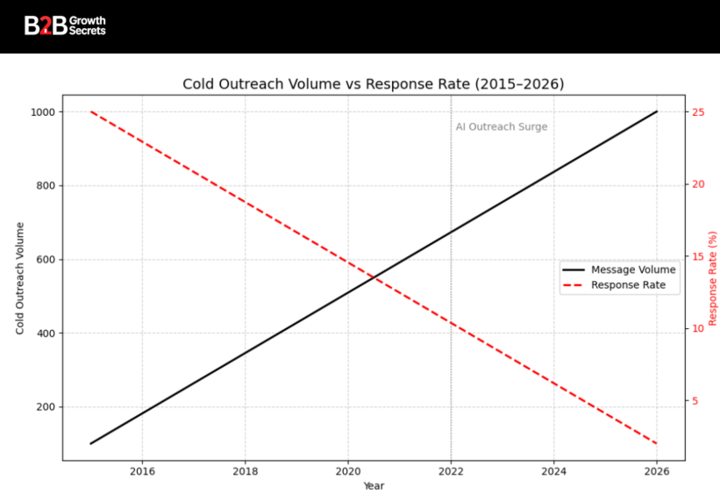
AI has saturated email, phone, and LinkedIn with "slop," making it harder than ever to reach prospects through traditional channels
Deep ICP research and human intelligence still dramatically outperform AI-driven spray-and-pray outbound
Tip: Target former employees of your prospect accounts; they're an untapped goldmine of strategic information no bot is accessing
Josh Gillespie spent 10 years building PandaDoc from zero to nearly $100M in revenue. Then he joined an AI startup and discovered something counterintuitive: AI has hurt modern sellers more than it's helped them.
The channels are dead
Every outbound channel available to sellers – email, phone, LinkedIn – has been flooded with AI-generated messages. Spam filters catch more legitimate outreach. Prospects ignore cold emails because they get thousands daily. LinkedIn just slashed message credits to “open profiles” from 800 to 100 per month specifically because of AI spam.
The result? Even a thoughtfully crafted, manually-written email gets lumped in with the garbage. Getting through the noise is "way more difficult than it's ever been," Gillespie says. "And we have one thing to thank for that – AI."
The "thousand conversations" approach
What actually works? Human intelligence gathering. Gillespie spent 80% of his time as an enterprise seller not on calls, but doing what he calls "Green Beret detective work" – reading earnings statements, scanning Glassdoor reviews, following executives on LinkedIn, and building a detailed map of each target account.
The best information, though, comes from people. Gillespie's secret weapon: building lists of former employees who left target accounts in the last year. His outreach goes something like this: "Hey, I was looking into your old company. I'm thinking about applying for a job there. Can I pick your brain for a few minutes?"
The response rate is excellent. Former employees share candid insights about internal problems, what CRM they used, why deals stalled – proprietary information no AI can scrape.
Why the spray-and-pray agencies are failing
Gillespie calls many GTM agencies "Ponzi schemes." They take on random clients across industries, never deeply understand the ICP, use AI-generated copy, blast everyone, burn through the client's total addressable market, then move on when results tank.
The alternative: build a top 50-100 account list, ruthlessly disqualify down to the perfect ICP, craft messaging without AI, and send relatively low volumes perfectly targeted with the right offer. "That does not happen with AI," Gillespie says. "It comes with human discernment, human understanding."
The bottom line
The best salespeople in 2026 aren't using AI to automate outreach – they're using it selectively for data synthesis while investing heavily in human conversations. The path to becoming a true subject matter expert hasn't changed: have a thousand conversations with the people nobody else wants to call. That's where the real competitive advantage lives.
2. Stop offering free POCs + it’s better to go bigger on fewer events
The SaaS podcast: How a Cold Text to McDonald's CMO Landed His First Enterprise Customer (1/17/26)
TLDR:
Getting your first enterprise logo often requires unconventional hustle: Blings landed McDonald's by texting the CMO’s phone number!
Always charge for POCs (even $3-5K) because free pilots put you at the bottom of the priority list
Event leads are worthless without a follow-up system: they wasted 70 leads and $30K before learning this lesson
Yosef Peterseil co-founded Blings, a personalized video platform now serving McDonald's, Mercedes, Meta, and Live Nation.
The cold text that started everything
Peterseil didn't have a sophisticated outreach strategy. Someone randomly gave him a phone number. He texted it.
"I sent this guy a text and he's like, 'What do you want from me?'" Peterseil recalled. "All I want is to meet. Could we just meet?"
That "guy" was McDonald's CMO. After a few follow-up calls, Peterseil got a meeting. Before the call, his team scrambled to create a personalized video concept showing how McDonald's could use their technology for their loyalty program. The CMO loved it.
That single cold text eventually turned into a paying customer and later an investor.
Why free POCs destroy your credibility
Blings initially did their McDonald's proof of concept for free. It took 8-9 months just to close the POC paperwork. Then they had to negotiate a separate commercial agreement, adding months more.
They made this mistake multiple times before learning a critical lesson: always charge something.
"If you give anything for free, you're just bottom of the food chain," Peterseil explained. "You just need everyone to have a little bit of skin in the game. If it's $3,000 to $5,000 just to show that they're serious."
Charging for POCs does two things: it signals you're a real vendor worth prioritizing, and it starts the procurement onboarding process. You're no longer a "maybe" – you're a line item.
The fix? Instead of separate POC and commercial agreements, they now do 13-month contracts with a one-month exit clause. If either party is unhappy after the first month, they can walk. Otherwise, it automatically converts to a full commercial deal.
The $30K event mistake nobody talks about
Blings went to a loyalty conference, collected 70 leads, and felt great about it. Then reality hit.
"We weren't really ready to intake 70 leads," Peterseil admitted. "We didn't have sequences set up. We didn't know how to grade them, prioritize them, or follow up systematically."
Those 70 leads went cold. The $20-30K spent on booth, hotels, and attendance generated essentially zero ROI.
The next year, they fixed it. Instead of spreading budget across ten small event presences, they went big at three events – speaking on stage, running masterclasses, and bringing customers to present case studies. The quality of conversations and lead-to-deal conversion improved dramatically.
The bottom line
Enterprise sales as an early-stage startup requires equal parts hustle and systems. Cold outreach can work if you're persistent and prepared. Free pilots signal desperation. And event leads are only valuable if you have the infrastructure to actually work them.
3. To stand out, highlight the risks in the buying decision… and how you address them
Consulting Leaders podcast: How to Double Your Consulting Revenues Through Buyer Focused Selling w/ Peter Strohkorb (1/12/26)
TLDR:
Flip from your sales process to aligning with the buyer's purchase process—ask "What do we look like from the buyer's perspective?"
The perfect moment to ask for referrals is whenever you hear a client say "thank you"—and always get them to call their contact first to ask permission
Address buyer risk head-on by naming what can go wrong—this sets you apart because competitors avoid the topic entirely
Peter Strohkorb spent 25+ years in corporate sales at Sony, Canon, Dell, and 3M before founding his advisory firm.
Reframe every call with this opening
Senior decision-makers hate being sold to. Strohkorb opens every exploratory call by "framing the conversation":
"Would you allow me to frame this conversation before we start? Let's agree this is not a sales call – it's an information call. If we find something worth exploring, great. If we find there's not a good fit, let's acknowledge it and walk away."
This removes pressure from both sides. The prospect relaxes because they've been given explicit permission to say no. And you've positioned yourself as an equal, not a pushy rep. The more senior the buyer, the better this lands.
Go beyond benefits to personal stakes
Most salespeople stop at ROI. "You'll save money, you'll get payback in six months." But Strohkorb pushes deeper: What happens to the decision-maker personally if this goes wrong?
Every buyer fears negative repercussions: falling out of favor with their boss, damaging their reputation, missing a promotion. That fear often causes paralysis – buying committees exist partly to diffuse blame.
Use questions to surface it: "What would happen if this decision goes badly?" Then flip it: "What would happen if this is hugely successful?" Paint the picture of a promotion, a bonus, a pat on the shoulder. Now you've connected your solution to their personal win.
Raise what competitors won't
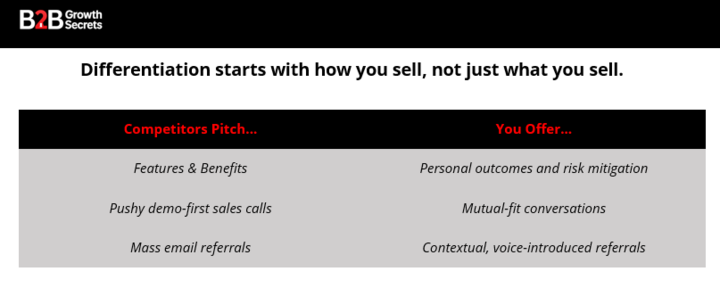
Here's a differentiator your competitors avoid: talk openly about what can go wrong. Ask prospects: "Would you like to know what specific risks you're exposed to in making this decision?"
They'll say yes. Then name the top three things that typically fail in your category. Finally, offer: "Would you like to know how we help clients avoid those risks?" Now you've positioned yourself as the only vendor addressing their real fears, not just pitching features.
The referral moment you're missing
Ask for referrals every time you hear "thank you." The client feels grateful, which triggers reciprocity. Say: "I'm glad you enjoyed what we did. Who else in your network would enjoy the same experience?"
Critical: don't ask them to send an email introduction. That email will be weak, and the recipient won't understand why they should care. Instead, ask your contact to call their connection and request permission to introduce you. This forces them to explain why the intro matters, and the referred person arrives expecting your outreach.
The bottom line
Stop forcing buyers into your sales process and start aligning with their purchase journey. Frame calls as mutual exploration, address personal stakes and buyer risk directly, and ask for referrals at the moment of gratitude. These aren't tricks; it’s how you build trust with decision-makers who've been burned by pushy sellers their entire careers.
Disclaimer
B2B Growth Secrets summarizes and comments on publicly available podcasts for educational and informational purposes only. It is not legal, financial, or investment advice; please consult qualified professionals before acting. We attribute brands and podcast titles only to identify the source; such nominative use is consistent with trademark fair-use principles. Limited quotations and references are used for commentary and news reporting under U.S. fair-use doctrine.
