
Why your event leads are dying (and how to fix it in 48 hours)
Welcome to B2B Growth Secrets, where every week, we listen to dozens of B2B Growth podcasts and extract the top actionable ideas. (For more context on these ideas, give the podcasts a listen)
Learn AI from builders in B2B. We're launching AI Skills workshops to help you understand trends, build custom tools, and automate workflows (taught by the CTOs / Heads of AI building AI tools in your industry, not trainers).
To save your spot as a Founding Member (50% lifetime discount), reply “Skills” (100 slots available, first come - first served).
In this issue:
Why your event leads are dying (and how to fix it in 48 hours)
Instead of optimizing your price point, start rethinking who and how you charge
A 3-layer outbound framework that can actually fill your pipeline
1. Why your event leads are dying (and how to fix it in 48 hours)
Coffee with Closers podcast: How to Close More Deals From Trade Shows and Conferences (1/8/26)
TLDR
The average company takes 11 days to follow up on event leads. By then, those "hot" prospects have forgotten you exist.
Event marketing is the single biggest line item in marketing budgets (20%+), yet most teams have no system to capture ROI.
The best people to send to events aren't executives. They're SDRs, AEs, and founders who need conversations to survive.
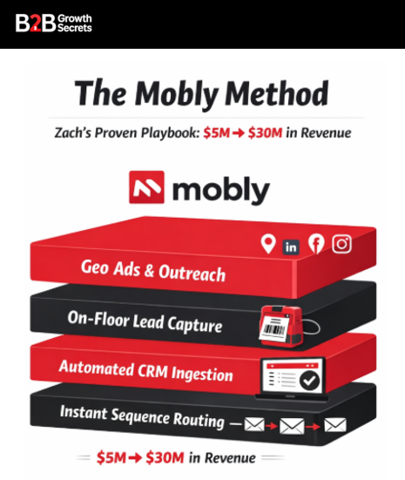
Zach Barney scaled US revenue from $5M to $30M as VP of Sales at Nearmap before founding Mobly, an event marketing platform. His insight? Event marketing is massively underserved by technology, and it's costing companies millions.
The 11-day problem that's killing your event ROI
The average company takes 11 days to follow up with event leads. Why? They're stuck exporting spreadsheets, cleaning data, enriching contacts, deduplicating records, and manually uploading to CRMs. Meanwhile, the average human attention span is 8.25 seconds. By day 11, that "hot lead" has talked to 50 other vendors and forgotten your booth entirely.
The fix isn't working faster. It's eliminating the manual process entirely. When Zach's team scans a badge now, that contact hits their CRM within minutes, fully enriched, properly tagged, and automatically routed to sequences. No spreadsheets. No data cleanup. No 11-day lag.
Stop sending executives to events
Most companies send senior leaders to events for "visibility." Zach says that’s a mistake. The best event ROI comes from three types of people: SDRs, full-cycle account executives, and founders.
Why? These people's livelihoods depend on talking to as many prospects as possible. They're hungry. They'll work the floor, push deals forward, and actually try to close on the spot.
Meanwhile, marketing teams often staff booths but lack the sales instinct to convert conversations into pipeline. If you're spending $20K+ on event sponsorship, send closers, not greeters.
The pre-event playbook that actually works
Before any event, Zach's team runs geo-targeted ads on LinkedIn, Facebook, and Instagram. The targeting? People physically in the event's hotel area who don't live there. These are almost certainly attendees. This primes prospects before they ever reach your booth.
They also scrape the attendee list (when available), enrich it, and reach out ahead of time. By the time they meet face-to-face, it's not a cold introduction but a warm follow-up.
His recommendation is to spend almost as much on pre-event marketing as you do at the event itself.
The bottom line
Events aren't a "branding play." That's what you say when you don't have attribution. Follow up immediately (within hours, not days), send hungry salespeople who will close on the floor, and prime your audience before you arrive.
2. Instead of optimizing your price point, start rethinking who and how you charge
Growth Capital podcast: The Strategic Power Hidden Inside Your Pricing Model with Daniel Balcauski (1/6/26)
TLDR
Most SaaS leaders obsess over the price number when the real leverage is in who you charge and how you structure your pricing.
Your pricing and packaging should flow directly from your positioning.
Token-based pricing for AI features is usually a knee-jerk mistake that confuses customers and kills sales velocity.
How Netflix killed Blockbuster (and it wasn't about the price)
Daniel Balcauski, founder of Product Tranquility, has spent years helping B2B SaaS companies between $20-50M ARR fix their pricing. His core insight: Most executives think what you charge determines success. In reality, it's who and how you charge that matters.
Consider the Blockbuster vs. Netflix story. Blockbuster charged per rental night. Netflix said: "Keep three DVDs as long as you want. Send them back, we'll send more." They changed the pricing dimension from time to number of movies, aligning with how customers actually got value. Nobody compared dollar amounts. They compared how the model fit their life.
Value lives in your customer's head, not in your product
Here's a mental exercise Balcauski uses: imagine water. At a gas station, you'd pay $1-2. Wandering the desert for a week? You'd pay almost anything. Water flooding your kitchen? Now it has negative value – you'll pay a plumber to remove it.
The same product, wildly different value. That's because value exists in the customer's context, not in your features. This is why Balcauski insists that every pricing project starts with deep clarity on positioning and customer segments.
If you're using firmographics alone (company size, industry), you're missing the point. Nobody wakes up thinking "I'm a Fortune 500 CMO… what should I buy?" They wake up with a specific problem in a specific situation.
The "good, better, best" test your team is probably failing
If you have tiered pricing, try this: can your team put a clear label on each tier saying who it's for? Not "Starter" and "Pro" but actual customer profiles.
Most companies can't, Balcauski says, because they haven't designed pricing around customer value.
When you do it right, your frontline sales rep finishes a discovery call and thinks: "Based on what they told me, I'm showing them this tier, with this demo script, leading to this offer."
The customer feels understood. Sales cycles shrink. Confidence rises on both sides.
Why charging by AI tokens is usually wrong
Many SaaS companies are adding AI features and panicking about cost. Their knee-jerk reaction: charge customers by tokens, mirroring how OpenAI charges them.
Bad idea. If you sell a CRM by seats, customers understand "10 salespeople = $1,000/month." Now explain tokens to them. "How many tokens will I use?" "What's a token?" You've just added friction and confusion to your sales conversation.
Better approach: create an add-on for AI features, or bundle them into higher tiers to incentivize upgrades. Protect your margins without destroying your sales velocity.
The bottom line
The biggest pricing wins don't come from A/B testing $49 vs. $59. They come from aligning your packaging to how customers actually experience value, and making sure your go-to-market team can explain exactly who each offer is built for in one sentence.
3. A 3-layer outbound framework that can actually fill your pipeline
Leaders in Growth podcast: Why Outbound Still Works for B2B SaaS (And How Most Teams Get It Wrong) (1/4/26)
TLDR
Most teams quit outbound too early. Your first failed campaigns provide the market feedback you need to win.
Stack three layers of outbound (cold, intent signals, and inbound-led) to build a sustainable pipeline engine.
You need two distinct roles to make modern outbound work: a GTM strategist and a GTM engineer.
Bill Stathopoulos scaled his agency SalesCaptain to $3M ARR by helping B2B SaaS companies build outbound engines. His core insight? Most founders assume outbound doesn't work because their first few campaigns flopped. That's exactly backwards: those failures are your market research.
Why your failed campaigns are actually gold
Every outbound campaign pinpoints one of three possible problems:
targeting problems (wrong audience),
messaging problems (right audience, wrong pitch), or
deliverability problems (technical issues).
Bill's framework is simple: deliverability is the easiest to fix, targeting requires knowing your ICP, but messaging is where most teams underinvest.
Here's the counterintuitive part: you need negative replies to learn and optimize. When a UK property management SaaS kept hearing "we're locked into yearly contracts," Bill didn't keep pushing demo calls. Instead, he changed the ask to "what software are you using?" and repositioned around contract renewal timing. That pivot turned a failing campaign into their highest performer.
The three-layer funnel most teams miss
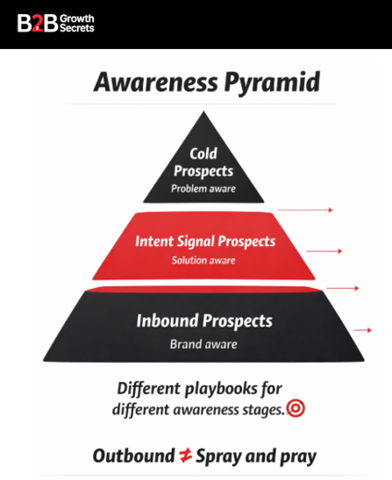
Bill breaks outbound into three layers based on buyer awareness.
The top layer is cold AI outbound: you pick a niche (say, Shopify brands doing $10M+) and reach out because they fit your criteria. This is a good starting point, but of course it's not enough.
The middle layer targets intent signals: people actively researching solutions. Someone following your competitor on LinkedIn, hiring for a related role, or posting in relevant communities. These prospects are solution-aware, not just problem-aware. Lower volume, but much warmer.
The bottom layer is inbound-led outbound: these prospects already know your brand – they've visited your site, attended your webinar, or signed up for a trial. They have the highest conversion rates but the lowest volume.
The key insight: stack all three layers to get both sustainable volume and high-converting leads.
The two roles you actually need
Here's what Bill learned from hiring dozens of people: the "unicorn GTM engineer" who does everything is nearly impossible to find. Instead, build a team with two complementary skill sets.
The GTM strategist understands positioning, messaging, and market dynamics. They can look at negative replies and diagnose whether it's a targeting or offer problem. They write copy that resonates.
The GTM engineer handles the technical implementation: connecting data sources, building workflows, and scoring leads. One thinks creatively, one thinks analytically. You need both.
The bottom line
Stop treating failed campaigns as proof that outbound doesn't work. Treat them as market research. Stack cold outreach with intent signals and inbound-led plays, hire for both strategy and technical skills, and remember: if you're talking to the right people with nothing interesting to say, you'll fail. Fix the offer first.
Disclaimer
B2B Growth Secrets summarizes and comments on publicly available podcasts for educational and informational purposes only. It is not legal, financial, or investment advice; please consult qualified professionals before acting. We attribute brands and podcast titles only to identify the source; such nominative use is consistent with trademark fair-use principles. Limited quotations and references are used for commentary and news reporting under U.S. fair-use doctrine.
