
SaaStr replaced sales reps with AI, and nothing broke
Every week, we listen to dozens of B2B Growth podcasts and extract the top actionable ideas. (For more context on these ideas, give the podcasts a listen)
In this issue:
How SaaStr replaced 10 salespeople with 20 AI agents
5x your SaaS growth using "Pattern Interrupts" in crowded markets
The three-bucket event strategy CMOs are using to prove ROI
Checklist for the Inner Circle (our paid community)
How to set up a sales / marketing AI Agent (workshop)
How to train an AI Agent (workshop)
Examples and ideas of “Pattern Interrupts” (webinar)
1. How SaaStr replaced 10 salespeople with 20 AI agents… and matched their performance
Lenny’s podcast: We replaced our sales team with 20 AI agents – here’s what happened next | Jason Lemkin interview (1/1/26)
TLDR:
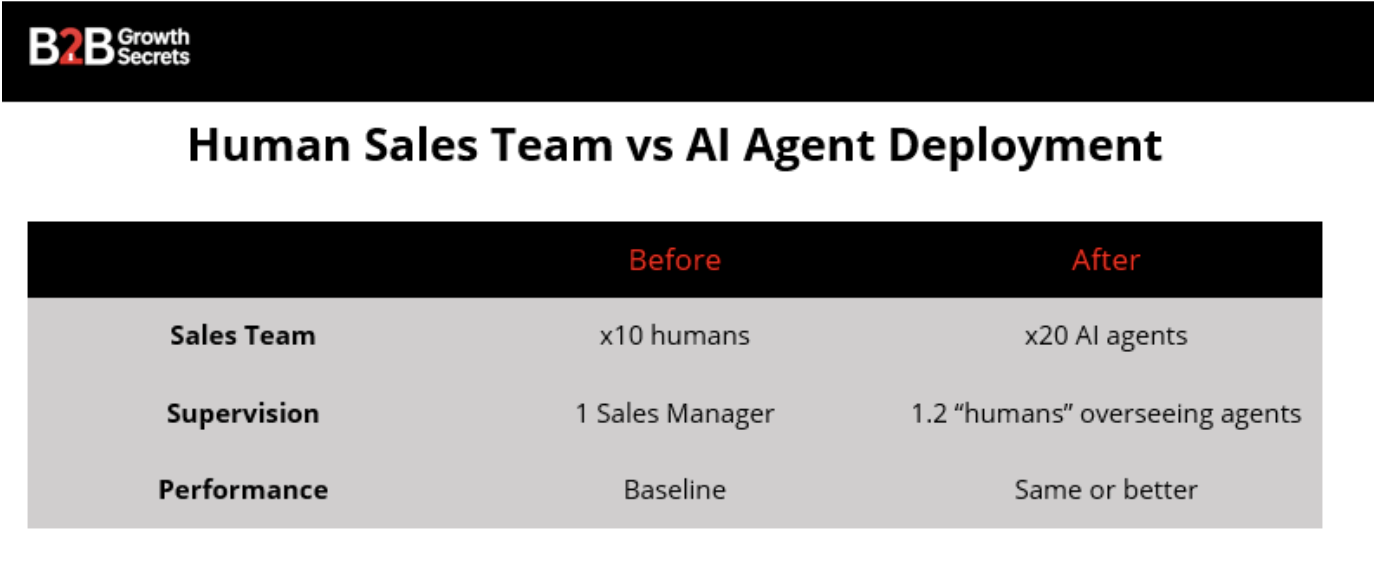
SaaStr's Jason Lemkin replaced his entire sales team with 20 AI agents managed by 1.2 humans, and the business performance stayed the same
Email-based SDRs and lead qualification roles will be "extinct" within a year
Anyone can become "hyper-employable" by spending 30-60 hours training one AI agent themselves
When two of his salespeople quit at SaaStr Annual, Jason Lemkin made a radical decision: no more hiring humans for sales. Instead, he deployed 20 AI agents to do what 10 people used to handle.
The moment everything changed
Lemkin had already seen proof of concept. Before making the switch, a general-purpose AI agent (not even trained for sales) had closed a $70,000 sponsorship deal on its own. That single data point convinced him to go all-in.
Today, SaaStr's office has 10 empty desks labeled with agent names: "Repli" for Replit, "Quali" for Qualified, "Arti" for Artisan. And performance matches what they achieved with their human team.
Which sales roles are disappearing
The classic SDR / BDR college hires sending email sequences? "We don't need them." The human who qualifies inbound leads before passing them to an AE? "They should be extinct next year."
His reasoning is simple: Why should a prospect wait two days for a 21-year-old who doesn't know your product to ask basic qualification questions? AI can fully qualify website visitors instantly and book meetings directly with salespeople.
For AEs, Lemkin estimates 70% of their jobs remain safe through 2026, but that number will drop to 40-50% as agents get better at closing deals where there's limited negotiation.
How to become the 20% who thrive
For anyone worried about their sales career:
Pick one painful problem – support, inbound qualification, etc. Choose a leading vendor (like Artisan or Qualified). Then do the work yourself.
Training an agent isn't complicated. You upload your website URL, wiki, training docs, and prospectus. The agent ingests it. Then you spend hours answering questions and correcting mistakes. After 30 days of spending an hour or two daily fixing errors, the agent gets good.
💡Almost no one spends the time to actually train an agent themselves. They expect magic. It doesn't work that way.
The bottom line
If you can spend 50-60 hours training one AI agent into production, you become what Lemkin calls "hyper-employable." Companies desperately need people who can bridge the gap between AI tools and real-world implementation. The technology is ready. The people who know how to use it are rare.
2. 5x your SaaS growth using "Pattern Interrupts" in crowded markets
The Sales Machine podcast: How We Grew from $2M to $10M: Pattern Interrupt Marketing in Crowded SaaS Markets episode (12/31/25)
TLDR:
The PIPE framework helps you identify tired industry patterns and break them to stand out in crowded categories
Storylane grew traffic from 20K to 250K monthly visits by replacing traditional blog content with interactive demos
Constraint breeds creativity: bootstrapped companies often out-innovate funded competitors
Madhav Bhandari helped scale Storylane from $2M to $10M ARR in two years without investor funding. His secret? A systematic approach to doing the opposite of everyone else, called the PIPE framework (Pattern Interrupt).
The problem with "standing out"
When your team asks "how do we differentiate?", there's no clear path forward. Everyone knows they should be different, but nobody knows how. Madhav built the PIPE framework to answer one specific question: what patterns exist in your industry that everyone follows without questioning?
For example, every B2B blog follows the same formula: text, images, subheadings. Storylane removed all of it and just embedded interactive product demos instead. The result? Organic traffic exploded from 20,000 to 250,000 monthly visits in six months. Google rewarded the novelty.
Apply pattern interrupts everywhere
The framework works across every channel.
At conferences, instead of paying $100K for a Dreamforce sponsorship, they hired a mobile billboard truck to park outside for $4K – same visibility, 96% savings.
For video ads, they partnered with comedy creators to make product skits instead of boring feature walkthroughs. The CPMs were dramatically better.
Even their swag stood out. While competitors handed out notebooks and pens, they chose unusual items that sparked conversations.
Why bootstrapped companies have an advantage
Having constraints forces innovation. Funded competitors throw money at agencies and expensive sponsorships. But when you have a $500K marketing budget instead of $15M, you can't do those things. You have to think differently.
Madhav treats marketing channels like an investment portfolio. They test, measure, and double down on what works.
Google Ads plateaued at $1M spend, so they shifted.
Brand investment kept scaling, so they kept pouring in.
The bottom line
Stop asking "how do we stand out?" and start asking "what patterns does everyone in our industry follow?" Then systematically break them. The PIPE framework isn't about being random. It's about being strategically contrarian. Find a pattern, interrupt it, measure results, repeat.
3. The three-bucket event strategy CMOs are using to prove ROI
Renegade Marketers Unite! podcast: The Event ROI Reality Check episode #499 (1/6/26)
TLDR:
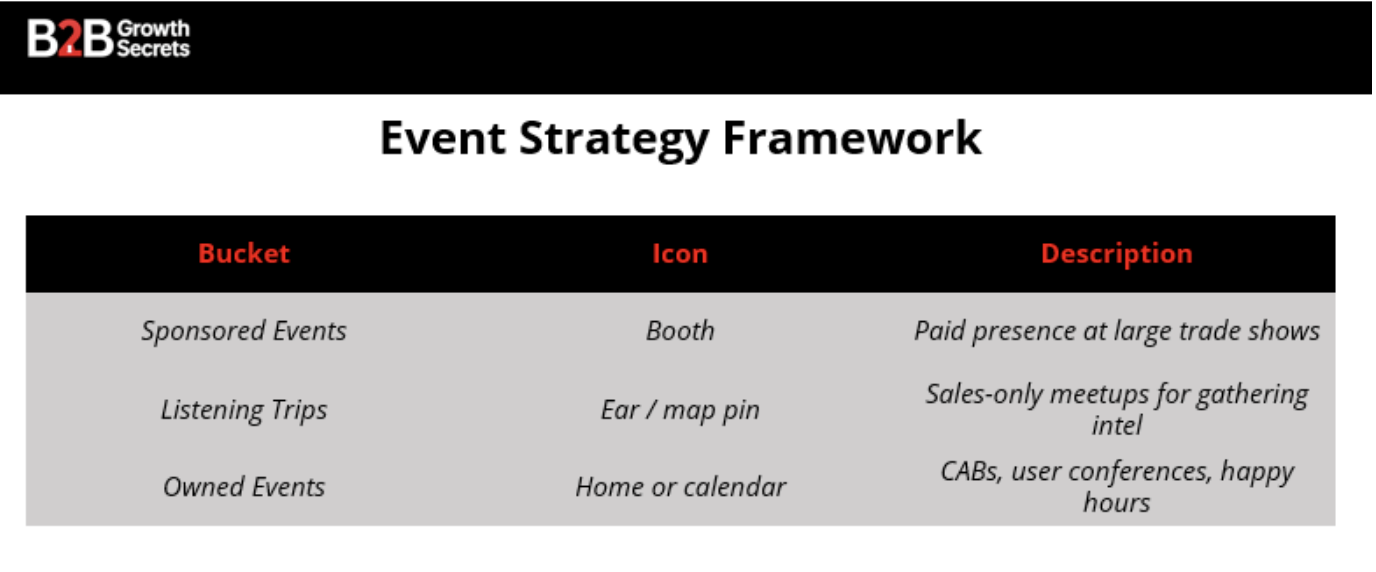
Categorize events into three buckets: sponsored trade shows, listening trips (sales attending small meetups), and owned events (CABs, happy hours)
Create "pods" of marketing + SDR + sales exec around key accounts, with shared KPIs on meetings booked before and during the event
If sales won't commit to pre-work, don't do the event
Events are the rare marketing channel that sparks both joy and frustration. CMOs love bringing customers together in person. They hate when sales doesn't book the pre-meetings and leaves ROI to chance. Drew Neisser brought together three marketing leaders – Charles Groom, Jamie Gier, and Lorie Coulombe – to dissect what's working in event strategy for 2026.
The three-bucket framework
Charles Groom, VP of Marketing at Insightful, organizes his event budget into three categories.
Sponsored events, where you're buying a booth at industry conferences.
Listening trips, where sales reps attend smaller regional meetups to gather market intel without a big marketing presence.
Owned events, including customer advisory boards, user conferences, and networking happy hours.
For 2026, he's leaning heavily into category two: the listening circuit. Send a sales rep with a mission to a small gathering, check if target accounts attended, and use that intelligence to decide if a bigger presence is warranted next year. It's low-cost reconnaissance that feeds both product feedback and sales pipeline.
The pod structure that drives accountability
Jamie Gier's approach focuses on making events drive deals. She creates pods – a demand gen person, an SDR, and a sales exec – around five key accounts. The pod agrees on shared KPIs: not just meetings at the event, but pre-work before, and follow-up after.
The key is gamifying it. Create friendly competition between pods. Track who books the most pre-meetings. Create a visible scoreboard. When individual reps aren't booking meetings, public visibility of that gap creates natural accountability – or as Jamie puts it, "a little bit of public shaming."
Make your booth memorable, not just present
Events require creativity, not just logistics. Jamie built a simulated mobile hospital as a booth for a healthcare client. It created an experience people walked into rather than walked past. The goal is "memory recall" – being remembered months later when the prospect is actually in-market.
The bottom line
Events work when sales and marketing are truly aligned. Before committing budget, get a handshake agreement on pre-work expectations and shared KPIs. Create pods around target accounts with visible scoreboards. And if you can't find a creative hook that will make your presence memorable, reconsider whether that event deserves your investment at all.
Disclaimer
B2B Growth Secrets summarizes and comments on publicly available podcasts for educational and informational purposes only. It is not legal, financial, or investment advice; please consult qualified professionals before acting. We attribute brands and podcast titles only to identify the source; such nominative use is consistent with trademark fair-use principles. Limited quotations and references are used for commentary and news reporting under U.S. fair-use doctrine.
