
Outbound is dying. Trust is replacing it.
Welcome to B2B Growth Secrets, where every week, we listen to dozens of B2B Growth podcasts and extract the top actionable ideas. (For more context on these ideas, give the podcasts a listen)
In this issue:
New Feature: Quick Takeaways
Growth hacking tactics and why you may be giving up on product-market-fit too soon
Cold outbound is dying (and what’s replacing it)
How to stop churning CMOs and start getting results from them
1. Quick Takeaways
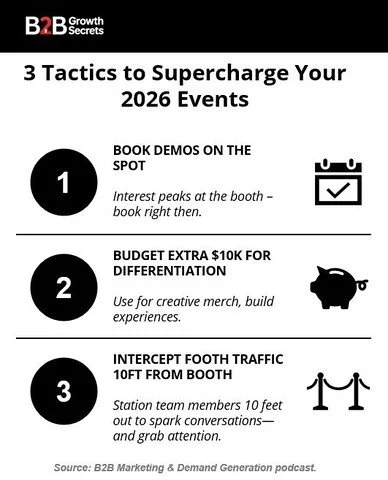
Three tactics to supercharge your events in 2026. One - book demos at the event, on the spot. Interest peaks when prospects are standing at your booth. Two - budget $10K+ beyond booth costs for differentiation (for creative merch, costumes, experiences). Three - position team members 10 feet out from the booth to intercept foot traffic. For example: Wiza's team wears costumes – wizard outfits, Willy Wonka themes – and hands out chocolate bars with "golden tickets" for prizes. Sounds gimmicky, but it works. In a sea of identical booths with stressed reps in polo shirts, visual differentiation stops traffic.
From: “Best B2B Event Marketing Strategy to Drive Leads (2026)” on B2B Marketing & Demand Generation podcast (11/19/25)
Elon Musk's thesis: as AI and robotics handle more work, in-person experiences become increasingly rare and valuable. Neil Patel admits the direct ROI on events is "no good." But the value shows up in unexpected places: relationships formed at dinners, partnerships sparked in hallway conversations, trust built over drinks. Eric Siu has hosted live events for years and consistently hears "when's the next one?" The in-person connection creates something digital can't match. Even in-person podcast recordings, which don't make financial sense, pay off through deeper relationships and conversations that wouldn't happen over Zoom.
From: “Elon Musk: Live Events Are The Only Remaining Luxury” on Marketing School episode with Eric Siu and Neil Patel (12/8/25)
Why most founders fail at paid acquisition. Romain Torres, founder of ARCads.ai, scaled his AI ad-generation startup from $5K to $10M ARR in just 20 months – completely bootstrapped. One of his core channels is paid ads. Most founders test paid ads with $100 and give up after a week. That's not a real test. ARCads runs 200+ Meta ads simultaneously, constantly testing different AI faces, scripts, and languages. Winning creative combinations emerge only after significant volume and time. The takeaway: commit meaningful budget (thousands, not hundreds) and run tests long enough to gather statistically significant data.
From: “He Scaled His Startup to $10M/yr Building AI Influencers” on Software Founder Interviews episode with Nathan Latka and Romain Torres (12/10/25)
2. Growth hacking tactics and why you may be giving up on product-market-fit too soon
Founders Bay workshop: Growth Hacking for Startups with No Traction (12/12/25)
TLDR:
You can’t decide if there’s product-market-fit (PMF) until you’ve spent 4x the time marketing your product as you did building it.
Build a daily 20-minute habit using Google Alerts to create a list of reporters, podcasters, and influencers in your space, and you'll have thousands of warm contacts within months.
The perfect cold outreach is 60% value proposition, 20% who you are (relevant to them), and 20% call to action. Shorter always wins.
Andrew Lee Miller has driven over $200 million in startup exits, mostly through growth hacking with minimal budgets.
Fix your foundation before scaling
Every founder Andrew works with says the same thing: "We need to scale. Everything's great. We just need more users." Then he pokes holes and finds messaging that's vague, websites that don't convert, and social profiles that signal "we're not a real company."
Before spending on growth, nail these basics: H1 text that intrigues (slightly vague), a subtitle that clarifies, one or two clear calls to action, and a minimalist navigation bar. For mobile products, create a nearly non-scrollable site that just pushes downloads.
Social profiles need regular posts – not for engagement, but to signal legitimacy to both humans and AI systems indexing your content.
The 80/20 rule most founders get backwards
Andrew sees founders spend 80% of their time building product and 20% marketing it, then assume the market doesn't exist when traction doesn't appear. Flip it: spend 4x the time marketing your product as you did building it before giving up.
His framework for limited time is "return on time investment" (ROTI). Block specific hours for each channel, track what's working, and optimize based on data. By the time you raise money, you'll already know which strategies work.
Build your media list in 20 minutes a day
Go to alerts.google.com and set up alerts for keywords in your space (like "real estate AI" or "real estate software news"). Every day, you'll get emails with new content mentioning those terms – revealing reporters, podcasters, conference organizers, and influencers.
Spend 20 minutes daily scanning these alerts and adding contacts to a spreadsheet. Reporter emails are usually on their author pages. Twitter handles are always available – just DM "What's your email? I have a story for you." Within three months, you'll have thousands of contacts for when you're ready to launch, fundraise, or announce something newsworthy.
The outreach template that works
Andrew's cold outreach formula:
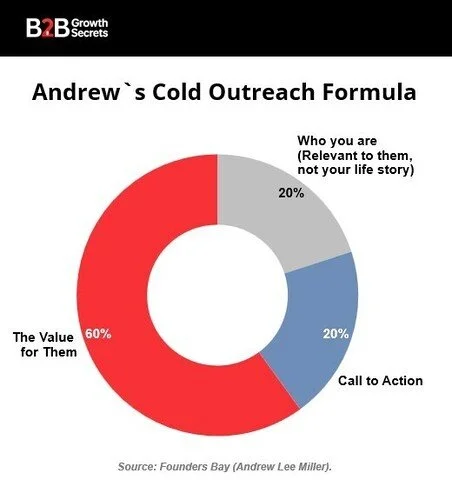
The shorter your message, the more replies you'll get.
One trick for getting past spam filters: start with "Hey" and ask a simple one-line question. "Hey Lisa, I was wondering if you still cover Bay Area startups?" This looks like a known contact, gets through filters, and earns a response you can build on.
The bottom line
Growth hacking isn't about clever tricks. It's about building a marketing foundation that converts, then systematically testing organic channels before spending money. The founders who succeed treat their time budget as rigorously as their cash budget, and build assets (like media contact lists) that compound over months.
3. Cold outbound is dying (and what’s replacing it)
Go to Network Academy podcast by The Swarm, From Cold Emails to Partner-Led Growth | Why Cold Outbound Is Dying with Will Taylor, co-founder @ AudienceLed (12/12/25)
TLDR:
Cold email response rates are collapsing while outbound volume keeps rising – the math no longer works.
You need to build relationships with the people your buyers already trust.
The trust deficit is killing cold outreach
Your buyers are overwhelmed, stressed about their jobs, and drowning in AI-generated emails and LinkedIn messages. They're not looking for another pitch in their inbox. They're turning to people they already trust – influencers they follow, vendors they already pay, and peers in their communities.
If you're operating outside your buyer's existing "sphere of influence," you're wasting time. Turning up volume just creates further diminishing returns for everyone.
The “go-to-network” alternative to “go-to-market”
Instead of blasting cold emails, partner-led growth (or "go-to-network") means surrounding buyers with trusted voices. In practice, this looks like activating third-party experts who already have your buyer's attention – through co-created content, joint webinars, or integration showcases with your tech partners.
The results: twice the distribution at 50% of the cost, 2-3x better ad performance, and deals that close 28% faster.
How to augment your existing motion
This doesn’t mean that you should eliminate cold outreach entirely. Instead, reduce volume and add a relationship layer to existing workflows. This could mean having SDRs use tools that surface warm connections before reaching out, or creating a dedicated role focused on navigating strategic relationships across influencers, advisors, and customers.
One experiment the podcast guest is running: "warm calling" using lists where every contact has a relationship with someone who trusts his company. The call isn't cold anymore when trust already exists in the chain.
The bottom line
AI is flooding every channel with content, making differentiation nearly impossible. The companies that will win are the ones that build real relationships with the people their buyers already trust.
4. How to stop churning CMOs and start getting results from them
The Marketing Share podcast, Why CMOs Don’t Last (And How to Fix It): Alan Gonsenhauser on Fractional CMO, PE Growth & AI (12/8/25)
TLDR:
Only 10% of CMOs meet weekly with their CFO – yet CFOs are the "first source of death" for marketing leaders.
Well-qualified leads generate 4x the pipeline; stop optimizing for volume when sales calls everything "crap."
When marketing, sales, product, and customer success are aligned, companies grow 19% faster and are 15% more profitable.
Alan Gonsenhauser, CEO of Demand Revenue, 11x CMO at PE-backed companies, and coach to 150+ CMOs says that most CMO failures come from alignment problems, not marketing problems.
The CFO relationship most CMOs neglect
The CMOs who build strong CFO relationships do three things: agree on unified measurement approaches, share honest progress on both wins and challenges, and problem-solve together to fix business issues.
The payoff: when marketing can speak finance's language and demonstrate impact on metrics like sales at-bats, pricing power, and win-loss ratios, budget conversations become collaborative rather than adversarial.
Stop chasing MQLs that sales ignores
You've heard this story: marketing hits their lead goal, sales complains the leads are garbage, and leadership wonders why pipeline is weak despite all the "activity." The problem is measuring the wrong things.
Leads that are well-qualified generate 4x the pipeline. That often requires slowing down to warm up leads before handing them to sales, creating actual service-level agreements between teams, and accepting that 600 unqualified leads are worth less than 50 that actually convert.
AI advice that actually helps
With 91% of companies doing something with AI but only 1% feeling good at it, the practical advice is: pick 2-3 tools, give your team training, and don't try to do everything.
Also, fix processes first, or you'll just "fail faster" with AI accelerating broken workflows.
The most important warning: don't let AI serve as your strategy. Everyone's using the same LLMs: if you rely on AI for strategic thinking, your competitors will know your playbook before you execute it.
AI is great for summarizing what happened in the past; you need humans for divergent thinking about what could be different.
The bottom line
CMO survival isn't about running better campaigns, it's about building relationships with CFOs, creating genuine alignment with sales, and focusing on qualified pipeline over vanity metrics.
Disclaimer
B2B Growth Secrets summarizes and comments on publicly available podcasts for educational and informational purposes only. It is not legal, financial, or investment advice; please consult qualified professionals before acting. We attribute brands and podcast titles only to identify the source; such nominative use is consistent with trademark fair-use principles. Limited quotations and references are used for commentary and news reporting under U.S. fair-use doctrine.
