
CEOs are losing trust in marketing, here’s why
Welcome to B2B Growth Secrets, where every week, we listen to dozens of B2B Growth podcasts and extract the top actionable ideas. (For more context on these ideas, give the podcasts a listen)
In this issue:
Your conference shouldn’t be about the content; it should be about creating genuine human connection
Don’t adopt “enterprise” strategies too soon (like complex ABM); instead, lean on in-person small-group events
The CEO confidence crisis: they see cutting-edge AI-driven playbooks on LinkedIn, yet their teams are running “business as usual”
1. Your conference shouldn’t be about the content; it should be about creating genuine human connection
Exit Five podcast, Episode: Behind the Scenes of Exit Five’s Drive 2025 event with Anna Vermillion and Allison Saxon (Oct. 16, 2025)
TLDR:
Events are no longer about content; they are about connection.
Structure your event around "Third Spaces": neutral grounds for human connection, not just lecture halls.
The era of the stuffy B2B conference is fading. People can watch keynotes on YouTube at 2x speed. If they are going to travel, convince their boss to pay, and leave their families, you need to offer something digital channels cannot: genuine human connection. The team at Exit Five doubled down on this strategy for their Drive 2025 event.
The "Third Space" Strategy
A "Third Space" is a sociological concept for a place that isn't work (first space) or home (second space). It's a neutral ground for community. For B2B events, this means moving away from packed agendas with back-to-back speakers.
Exit Five intentionally lightened their programming to prioritize excursions like pickleball, boat cruises, and group walks. These aren't just "perks"; they ARE the product.
When you put people in a low-stakes environment (like a breakfast table or a hiking trail), barriers drop. They stop pitching and start bonding over shared realities – like explaining what a CRM is without the other person's eyes glazing over.
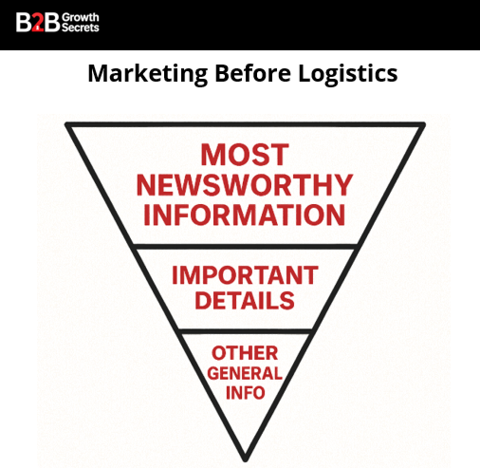
Tip: Marketing Before Logistics
Most teams start planning an event by booking the venue and catering. You should start with the landing page. Writing the copy for the landing page forces you to clarify the "hook." Why would someone come? Who is it for? What is the promise?
If you can't sell the event on a landing page, no amount of fancy catering will fix it. Once the story is clear and tickets start moving, then you solve the logistics.
The Bottom Line
Don't measure your event success by how many speakers you cram onto a stage. Measure it by the NPS score and the connections made in the hallways and on the excursions. Your attendees want a tribe, not a lecture. Give them the space to find it.
2. Don’t adopt “enterprise” strategies too soon (like complex ABM); instead, lean on in-person small-group events
Growth Warriors podcast, Episode: Why Most B2B Marketing Doesn’t Work - and how to fix it - with Mark Cann & Reggie James (Nov. 17, 2025)
TLDR:
CMOs in Private Equity (PE) backed firms have a very short runway to prove value.
Scale-ups often fail by blindly copying Enterprise playbooks (like complex ABM) too early.
Offline, intimate events are making a comeback as a way to build genuine community.
When PE acquires a B2B company, the rules change overnight. The culture of "testing and experimenting" often shifts to a demand for immediate, predictable returns. Marketers in this environment must adapt their strategies to survive the scrutiny.
The Scale-Up Trap
A common mistake growing companies make is adopting "Enterprise" strategies too soon. For example, a $5M ARR company might try to run a complex Account-Based Marketing (ABM) motion like a $500M company. But traditional ABM is resource-intensive and slow.
Instead of copying the giants, scale-ups need a compromise. If necessary, you can use modern tools (like Clay) to run "intelligent outbound" – personalized and scalable – rather than bogging down the entire organization in a heavy ABM restructure.
The Return of the "Offline" Community
That said, EVERYONE is using Clay, AI SDR, and other tools to bombard the same audiences with unlimited “personalized” messages. Digital noise is at an all-time high. This has driven a resurgence in offline events. Specifically, small, intimate dinners or breakfasts.
These aren't sales pitches. The rule is "safe environment, no selling". If you bring five CMOs together to discuss shared challenges, you build deep trust. When they are ready to buy, they will call you. It’s hard to attribute this directly to a specific touchpoint, but it is often the deciding factor in high-value deals.
Keep doing it with a monthly cadence. Help your clients build their network, get battle-tested answers to their problems from peers, and they will remember you. Not because of the food but because of the tremendous value you’ve added: strong career-defining relationships they otherwise wouldn’t have.
The Bottom Line
If you are stepping into a PE-backed role, know that your timeline for results is accelerated. Don't over-complicate your strategy with enterprise bloat. Test efficient, scalable outbound and focus on building genuine trust through intimate, non-salesy offline interactions.
3. The CEO confidence crisis: they see cutting-edge AI-driven playbooks on LinkedIn, yet their teams are running “business as usual”
Truth, Lies & B2B Growth podcast, Episode: Why legacy B2B marketing strategies are killing your growth (Nov. 19, 2025)
TLDR:
CEOs are seeing LinkedIn flooded with "new playbook" content while their marketing teams run the same events and blogs as last year – and they're right to be concerned!
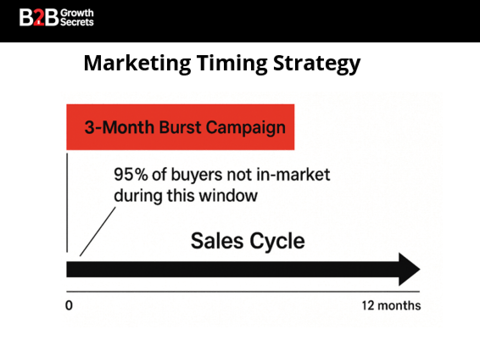
Three-month "burst campaigns" are mathematically incompatible with 6-12 month complex sales cycles; only continuous programs can influence buyers.
Your website needs to stop being a brochure and start enabling buying jobs: assessments, calculators, business case builders.
The pressure crushing marketing teams
CEOs who were already skeptical about marketing ROI are now seeing constant LinkedIn content about AI-driven approaches, data-driven tactics, and new methodologies. Meanwhile, their marketing teams are doing what they've always done: running events, updating the website, publishing blogs.
This creates a crisis of confidence. The CEO wonders: is my team behind? Is marketing even working?
The marketers, meanwhile, are trapped in "business as usual" mode: overstretched, under-resourced, and unable to experiment with new approaches because failure could cost their reputation internally.
Add to this: sales has slowed for many organizations, so marketing is needed more than ever, but scrutinized more harshly when it can't demonstrate clear pipeline impact.
Why burst campaigns fail complex B2B sales
The math doesn't work. If your sales cycle runs 6-12 months and only 5% of your market is actively buying at any time (the 95-5 rule), a 3-month campaign will reach a fraction of potential buyers. You'll spend heavily, capture whoever happens to be in-market during that window, and completely miss everyone who will start buying in month four, five, or six.
Agencies love burst campaigns because they're packaged deliverables with defined scope. But for complex, conversational B2B sales – where buying decisions require multiple stakeholders and extended evaluation – the approach is fundamentally misaligned.
The alternative: continuous programs that build brand recognition over 12-18 months. This requires faith from leadership, which is why many organizations default to the "easy" burst approach, get disappointing results, and become even more skeptical of marketing.
The shift from company brands to personal brands
Look at any company page on LinkedIn versus founder content from that same company. Company pages still get follows, but engagement and trust flow to individuals. For complex sales where trust is paramount, this creates a clear imperative: get your founders and experts visible.
This isn't just about LinkedIn algorithm preferences. Buyers in complex B2B want to know who they'll work with. They want to see expertise demonstrated, opinions shared, and real humans behind the business.
Synthesia-style AI video might work for simple SaaS products, but conversational, high-stakes sales require genuine founder-led content.
What your website should actually do now
Traffic is going to decline as AI answers more queries directly. But the traffic that does arrive will be further down the funnel. People who've already done research and are now evaluating solutions.
This means your website needs to stop functioning as a thought leadership library and start enabling buying jobs.
What tools help prospects build a business case internally?
Do you offer assessments that diagnose their current state?
Are there calculators that help them understand ROI?
When you map buyer journeys and identify what information people need at each stage, the "light bulb goes off". Websites have massive gaps in content that helps advanced buyers progress toward a decision.
Disclaimer
B2B Growth Secrets summarizes and comments on publicly available podcasts for educational and informational purposes only. It is not legal, financial, or investment advice; please consult qualified professionals before acting. We attribute brands and podcast titles only to identify the source; such nominative use is consistent with trademark fair-use principles. Limited quotations and references are used for commentary and news reporting under U.S. fair-use doctrin
